
Quick Overview
The best overall free plan comes from Brevo, with its unusually high send allowance and a free CRM layer most competitors don’t offer at all. The easiest email marketing platform to learn is MailerLite, which has a genuinely clean editor even after its recent free-tier cuts. Kit is the most durable free-forever option for a 10,000-contact ceiling with no expiration date. The most powerful free ecommerce automation comes from Klaviyo, which gives away its full workflow builder at a tight send volume. The best email marketing tool for ecommerce on a zero budget is Omnisend, with abandoned cart recovery built into the free tier. The best free CRM pairing is HubSpot, for a genuinely large free contact database tied to sales pipeline tools. The cheapest, once you’re ready to pay, are Moosend and Brevo’s entry-paid tiers, both starting at $9 a month.
Every business asking about the best email marketing software eventually asks a second question: what’s the cheapest email marketing software that still does the job right? I’ve spent years testing, researching, and working hands-on with email marketing platforms to answer both at once.That experience spans agencies, ESPs, and technology providers, including direct program work for brands like Hilton, Jockey, and P&G. Testing platforms from the agency side and running real enterprise programs are two different kinds of exposure, and this review leans on both: a free plan that looks generous on a features page gets judged here by whether it holds up once a real campaign is running on it.
Best Free & Cheap Email Marketing Software At a Glance
| Platform | Free plan | Contacts | Emails/month | Automation on free tier | Best for | Paid plan starts at |
| Brevo | Yes | Unlimited stored | ~9,000 (300/day) | Basic workflows | Startups, multichannel | $9/month |
| MailerLite | Yes | 250 | 2,500 | Up to 3 automations | Beginners | $12/month |
| Benchmark Email | Yes | 500 | 3,500 | None | Small business | $19/month |
| GetResponse | Yes | 500 | 2,500 | Workflows creatable, segmentation limited | Growing businesses | $19/month |
| AWeber | Yes | 500 | 3,000 | Basic autoresponders | Newsletter senders | $15 month |
| Omnisend | Yes | 250 | 500 | Prebuilt workflows | Ecommerce | $16/month |
| Kit | Yes | 10,000 | Unlimited | 1 workflow only | Creators and bloggers | $39/month |
| Mailjet | Yes | 1,000 | 6,000 | Basic | Transactional email | $9/month |
| Mailchimp | Yes | 250 | 500 | None | Beginners, with caveats | $13/month |
| Klaviyo | Yes | 250 active profiles | 500 | Full workflow builder, capped by volume | Ecommerce CRM depth | $20/month |
| HubSpot | Yes | 1,000,000 (CRM) | 2,000 | Basic workflows | CRM integration | $20/month |
| Moosend | No free plan | — | — | — | Small business on a budget | $9/month |
| ActiveCampaign | No free plan | — | 100 to 100 contacts on 14-day trial | — | Automation depth | $15/month Billed Annually |
| Constant Contact | No free plan | — | — (30-day trial) | — | Event and social marketing add-ons | $12/month |
Reviews of Best Free Email Marketing Software
Brevo
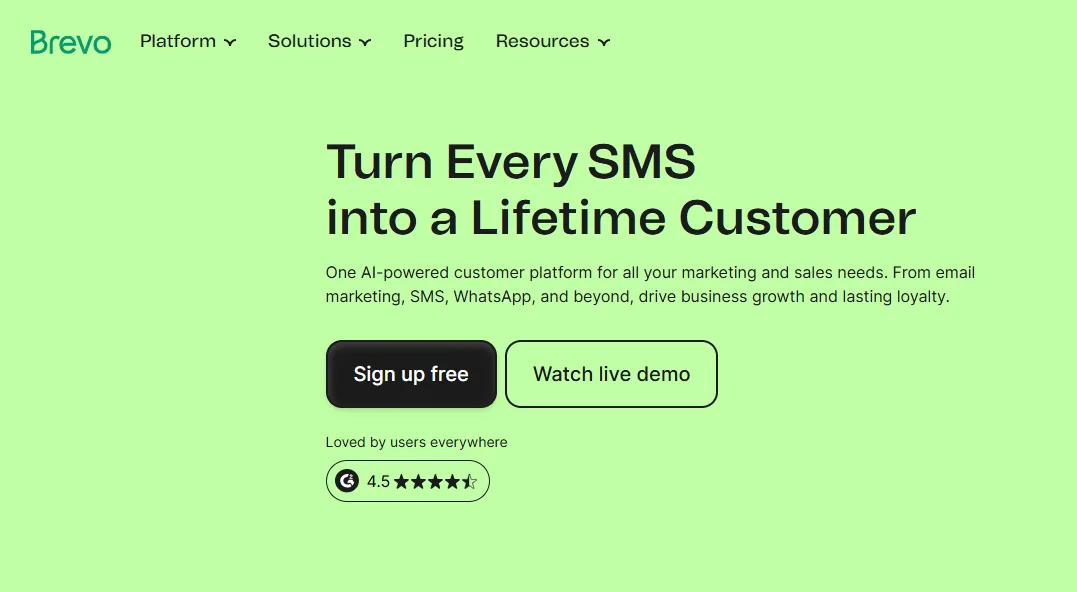
Brevo is the email marketing solution I point cash-strapped founders to first, and its pricing structure is part of why. Brevo meters by email volume, so the free plan stores an unlimited number of contacts and caps sending at 300 emails a day, roughly 9,000 a month.
What impressed me during testing:
- A functioning CRM layer included free
- SMS and WhatsApp messaging available on the same free account
- Basic automation workflows, enough for a real welcome sequence
Where it falls short: the template library sits around 40 designs, thinner than MailerLite’s or AWeber’s. If design variety matters more to you than raw send volume, that’s worth weighing before committing.
Pricing: Paid plans start at $9 a month for 5,000 emails, with contact storage staying unmetered even on entry tiers.
Verdict: The best free plan in this comparison for anyone whose priority is list size and multichannel reach over polish.
For email marketing solutions beyond this, look into our Brevo alternatives for businesses across sectors.
MailerLite
MailerLite’s free tier changed this July, dropping from 500 subscribers and 12,000 emails to 250 subscribers and 2,500 emails a month. In exchange, free accounts gained a second user seat and a custom HTML editor, both previously paid-only features.
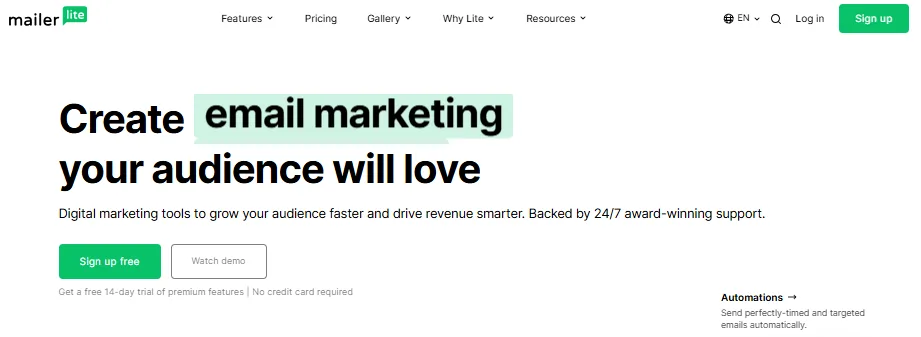
I still recommend MailerLite constantly for first-time senders. The editor is the cleanest I tested across all thirteen email marketing software, and even under the tighter limits, it handled a full onboarding sequence without friction.
Free plan highlights:
- Up to 3 automations, enough for a welcome flow
- A landing page, signup forms, and a basic website builder
- Deliverability that held up well in our own send testing
Limitation worth flagging: the interface supports only three languages, which has tripped up a couple of our international client accounts.
Pricing: MailerLite’s Comfort (formerly Growing Business) plan used to start around $10/month for 500 subscribers, but after the June 2026 reprice it starts at $12/month for the same tier.
Benchmark Email
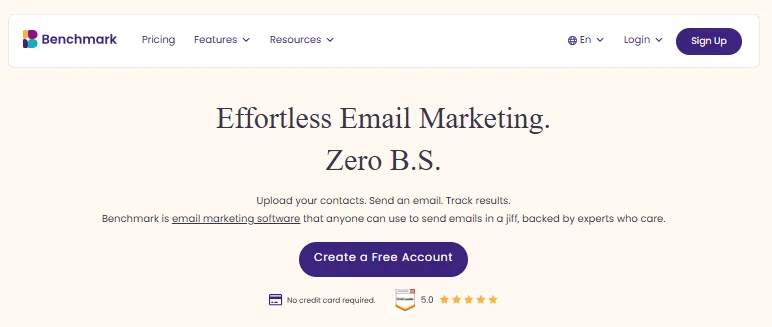
Benchmark gets small businesses running fast, and that’s really its whole pitch. The free plan gives 500 contacts and 3,500 emails a month.
What you get on the free tier:
- The full drag-and-drop editor, including AI-assisted subject line and copy tools
- Basic segmentation by demographics or custom fields
- Google Analytics built in, a rarity at this price point
What you don’t get, and this surprised me during testing: any automation at all. No welcome sequences, no drip campaigns, nothing behavior-triggered. Landing pages can be built and previewed but not published without upgrading.
Pricing: $19 a month once you’re ready to pay.
Verdict: Solid for a business in need of free email newsletter service, but it doesn’t support anything that needs to run on autopilot.
GetResponse
GetResponse’s free plan surprised me on one point specifically: automation workflows can actually be created and published. That’s rarer than it should be at this price tier.
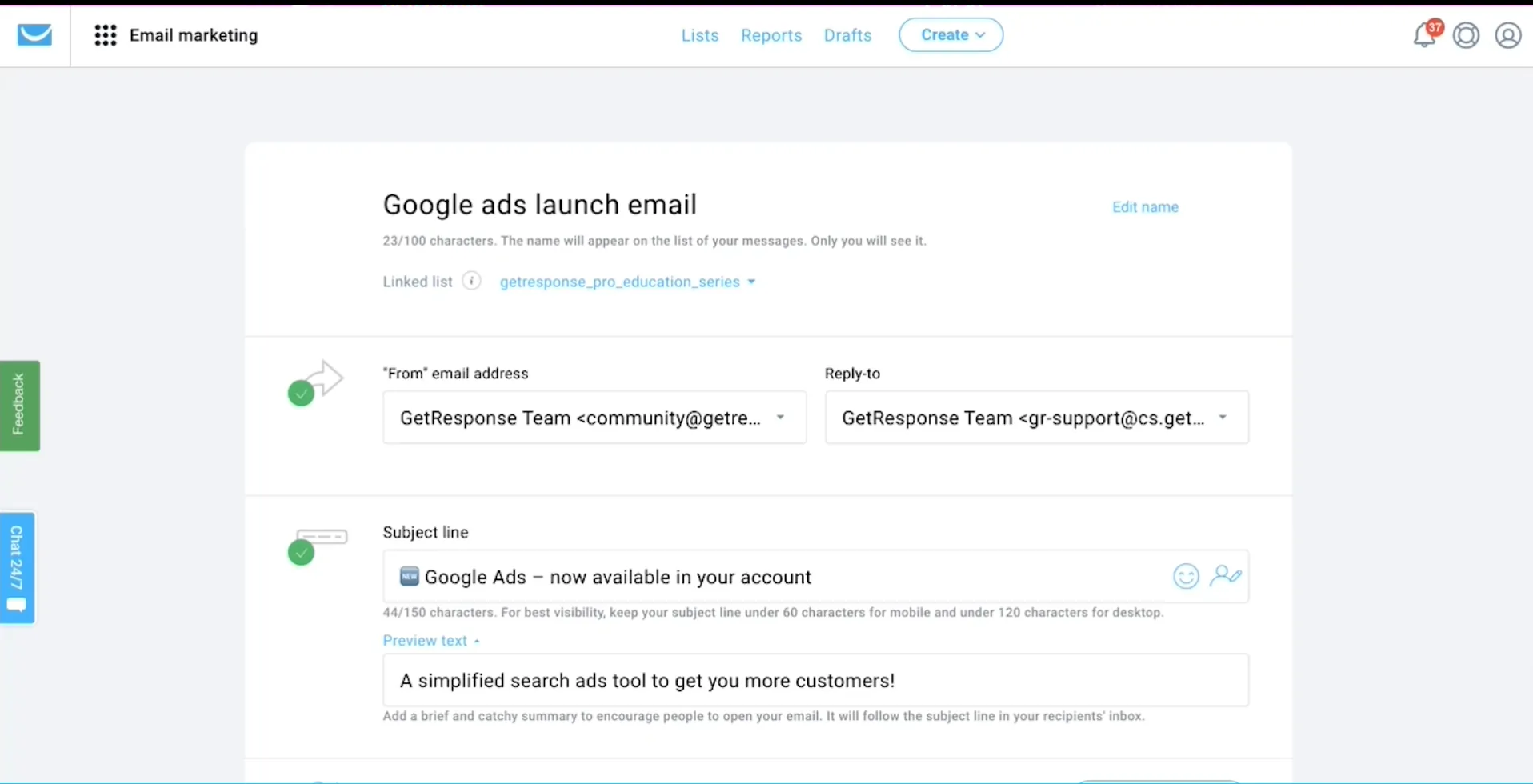
The free plan includes:
- 500 contacts, 2,500 emails a month
- Unlimited landing pages, capped at 1,000 visitors monthly
- A website builder tied to a custom domain
The gap: no dynamic segment filtering, so any workflow you build stays broad. Webinars are capped at ten attendees with one recorded session. GetResponse branding shows up throughout the free tier.
Pricing: $19 a month unlocks dynamic segmentation and full webinar access.
AWeber
AWeber has been around since 1998, and its free plan reflects decades of iteration on one specific problem: making an email look professional fast. The Smart Designer tool pulls a branded template automatically from your website URL, a feature I haven’t seen matched free on any other email marketing solution in this list.
Free tier specifics:
- 500 contacts, 3,000 emails a month
- Canva integration built directly into the email editor
- Basic autoresponders for simple sequences
Automation is the honest weak point here, and it stays basic even after upgrading. There’s no visual workflow builder on any AWeber tier, paid included.
Pricing: $12.50 a month (annual) and $15/mo for monthly billing, competitive for unlimited sends at that contact size.
Omnisend
Omnisend built its free plan around one specific ecommerce email marketing need: recovering abandoned carts, and it shows.
Free plan contents:
- 250 contacts, 500 emails a month
- 500 web push notifications and 60 trial SMS credits
- Prebuilt automation for welcome series, abandoned cart flows, and post-purchase follow-up
- 24/7 live chat support on the free tier, unusual anywhere in this list
I had a cart-recovery workflow running on a test account in under an hour, since the templates pull product data straight from a connected store. The tradeoff is scale: 250 contacts disappears fast for any store with real traffic, and advanced reporting stays locked behind a paid plan.
Pricing: $16 a month for 500 contacts.
Kit
Kit’s free plan hinges on one number that outpaces everything else here: 10,000 contacts, free, with unlimited sends and no time limit.
What creators actually get:
- Unlimited broadcasts and unlimited landing pages
- One automation rule and one signup form
- A tagging system and Creator Network built for cross-promotion among writers
The catch: that single automation rule can’t run a proper multi-step welcome sequence, so anything beyond a one-off autoresponse needs the paid Creator plan. There are no third-party integrations on the free tier either, and Kit uses free-account content in its own promotion, worth knowing before publishing anything you’d rather keep private.
Pricing: $39 a month for 1,000 subscribers, reflecting the monetization tools bundled in.
Mailjet
Mailjet solves a problem most free and cheap email marketing software on this list don’t touch: running marketing and transactional email through one system.
The free plan gives:
- 1,000 contacts, 6,000 emails a month
- A real SMTP and API setup for receipts and order confirmations
- Built-in email validation and deliverability reporting, features usually gated behind paid tiers elsewhere
Automation stays basic, and the forms and landing page tools feel like an afterthought next to the transactional infrastructure. For a developer-led team, I’ve found that tradeoff worth making.
Pricing: $9 a month, with unlimited contacts included from the entry tier.
Mailchimp
Mailchimp’s free plan took a real hit in January 2026, dropping from 500 contacts and 1,000 sends a month to 250 contacts and 500 sends, with a daily cap of 250. Multi-step automation had already been removed from the free tier before that.
What’s left:
- A basic editor and one audience list
- Limited templates
- Mailchimp branding on every send
I’ll be direct here: 250 contacts covers almost nothing for a real business, and I’ve started actively steering clients away from Mailchimp’s free tier toward Brevo or MailerLite, both of which now offer meaningfully more for the same cost of zero. What Mailchimp still has going for it is name recognition and an integration library running over 300 apps.
Pricing: $13 a month for 500 contacts.
Klaviyo
Klaviyo is the one email marketing tool in this list that gives away its complete ecommerce‑grade flow builder for free, with the same visual editor as paid plans, capped only by 250 profiles and 500 sends.
Free plan details:
- 250 active profiles, 500 emails a month
- 150 SMS or MMS credits
- The full visual flow builder, plus ecommerce data sync
What’s missing: A/B testing on email campaigns and flows, and support drops from live chat to community forums after your first 60 days. The 500-send limit can be a deterrent for most businesses.
Pricing: $20 a month for 251 to 500 contacts.
If these features aren’t enough to convince you, check out Klaviyo alternatives to create your successful email campaigns.
HubSpot
HubSpot’s free CRM is genuinely one of the more generous things in this entire market: up to a million contacts stored at no cost, since HubSpot charges for marketing sends rather than CRM storage.
The marketing tier layered on top of that free CRM includes:
- 2,000 marketing emails a month
- 20 landing pages
- One sales pipeline
- A website and blog tool, plus social ad management
For a client who wants email and sales tracking under one roof without paying for two separate tools, this is the widest free net I found anywhere in this comparison. The trade-off shows up fast once you outgrow it: costs climb steeply past the free and entry tiers, and the sheer number of modules means new users spend real time figuring out what they actually need.
Pricing: HubSpot’s entry-paid options include a Starter Customer Platform at $20/month per seat and a Marketing Hub Starter at $50/month for 1,000 contacts.
Reviews of Cheap and Affordable Email Marketing Software
Moosend
Moosend skips the free tier and goes straight to a 30-day trial. Where Moosend earns its place is what happens after that trial ends. At $9 a month, its entry tier includes:
- Unlimited email sends from day one of paying, no volume caps to track
- A single pricing tier structure, meaning you pay more only to raise contact limits
- Automation with 25 or more available triggers, including website-behavior tracking
For a small business that’s already decided to pay something, Moosend’s low entry price with full features has outperformed a few “free” email marketing systems with thinner feature sets in our own client work.
ActiveCampaign
ActiveCampaign offers a 14-day trial, capped at 100 emails to 100 contacts, just enough to get a feel for the automation builder before deciding.
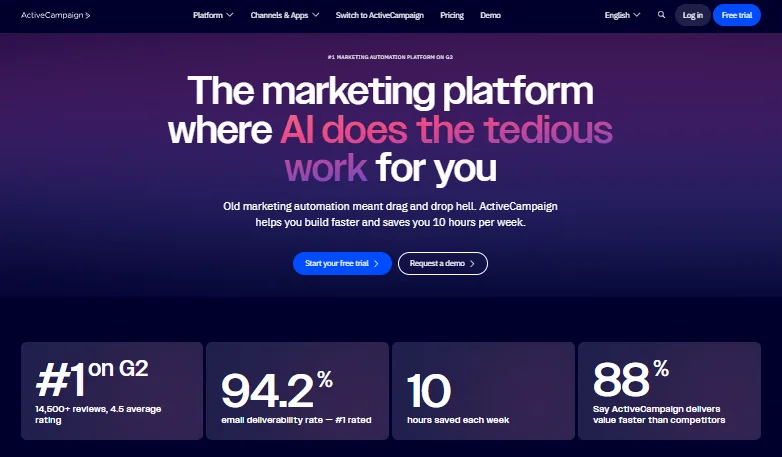
Once paid, plans start at $15 a month for 1,000 contacts and 10,000 emails, and the email software ships with over 900 workflow templates, more prebuilt automation than any other email marketing tool in this comparison.
Verdict: The $15 entry price with advanced automation suits marketers already committed to paying.
Constant Contact
Constant Contact doesn’t offer a free plan, only a 30-day trial, and I want to be upfront about that before anyone assumes otherwise from a name this recognizable.
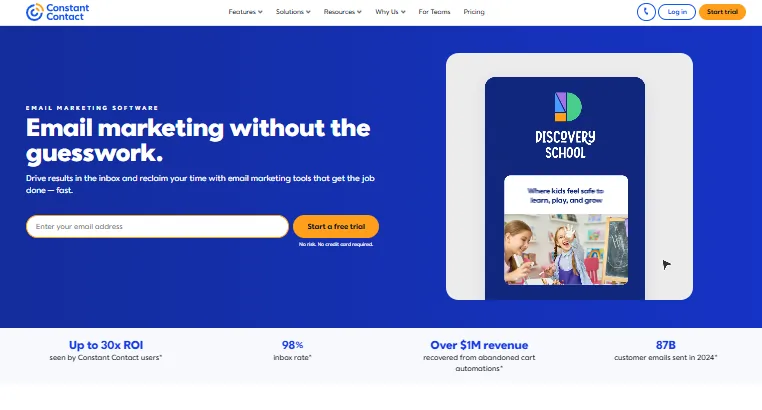
Where it earns a place in this list anyway is what you get once you do pay. At $12 a month for 500 contacts and 5,000 emails, the email marketing system bundles in things most email-first competitors don’t touch:
- Social media scheduling alongside email campaigns
- Event invitations and registration tracking
- A 300-plus template library
For a local business running events or workshops alongside a newsletter, I’ve found that bundle worth the entry price even without a free tier to test-drive first. It’s a narrower use case than most automated email platforms in this list, but for that specific need, it does the job well.
Pricing: $12 a month, no free plan.
Free & Cheap Email Marketing Software with Best Forever Plan
Two email marketing software in this list stand out as genuinely durable free options. Brevo’s advantage is send volume with zero cap on stored contacts, paired with CRM and multichannel tools most competitors charge for outright. Kit’s advantage is different: unlimited sending to a full 10,000-contact list, with a single automation rule as the only real ceiling.
I’d point a founder managing a large early list on no budget toward Brevo. I’d point a creator building a monetizable audience toward Kit. Both happen to solve different problems without an expiration date.
How to Choose the Right Marketing Automation Tool / Best Email Autoresponder Software
Not every business needs the same depth of automation, and paying for workflow features you’ll never touch is one of the more common budget mistakes we see. The right choice usually comes down to one honest question: are you sending a simple autoresponder sequence or building something closer to a full behavioral funnel? The best email autoresponder software for one need can be entirely wrong for the other.
Automation
Welcome email sequences and basic timed follow-ups are covered free on MailerLite, Omnisend, and Klaviyo. Anything behavior-based, like tagging a contact after they browse specific pages or catching an abandoned cart mid-checkout, needs the email marketing tool to track real activity. Omnisend and Klaviyo both include that free. Benchmark and Mailchimp skip automation on their free tiers entirely.
A gut check I use this with clients: count how many follow-up emails a new subscriber currently gets from you by hand. Zero or one, a free plan with basic autoresponders covers you fine. Three or four: automation depth deserves real weight in your decision.
- Newsletter senders are covered by MailerLite or GetResponse’s free automation.
- Ecommerce stores planning cart recovery from day one should start on Omnisend or Klaviyo.
- Anyone certain they need conditional, branching workflows should budget for ActiveCampaign or a paid Moosend plan up front and treat any free trial purely as a look at the editor.
Templates & Builder
Every email marketing system reviewed here gives free users the full editor, no stripped-down version. Benchmark’s free tier even includes AI-assisted subject lines and copy tools. Content-block editors like MailerLite’s and Moosend’s lean less on premade templates, since the blocks themselves function as a layout starting point. Custom HTML support for free is rarer; MailerLite added it this year, while most competitors still hold it back for paid plans.
List Management & Segmentation
Basic segmentation by signup source or a custom field shows up on nearly every free plan we’ve researched, Benchmark and GetResponse included. Layering several conditions to build a genuinely narrow segment is where free tiers run out of room. Omnisend and Klaviyo build segmentation around real store data at the core. Most general automated email marketing software save that depth for a paid plan.
Integrations
From what we have seen across the email marketing services, Shopify, WooCommerce, and Zapier support differs sharply, even among free tiers. Omnisend and Klaviyo sync store data directly; no separate connector needed.
MailerLite and Benchmark route through Zapier, an extra setup step that still reaches most common tools. Kit skips third-party integrations on its free tier completely, a deliberate choice tied to its creator focus. HubSpot’s integrations extend well beyond email into CRM and sales, though the free tier only opens part of that.
Reporting & Analytics
Open rates, click rates, and deliverability numbers are standard across every email automation software here, free tier included. Click-overlay maps, email list growth by source, and analytics integrations show up far less often for free.
Benchmark includes Google Analytics on its free plan, which is genuinely uncommon at this price point.
Automation-specific reporting only matters where automation exists at all, which rules it out on Benchmark’s and Mailchimp’s free tiers by default.
Support
Live chat on a free plan is rare. Omnisend and Benchmark both offer it.
GetResponse includes 24/7 chat on its free tier too, worth noting given how limited its automation and segmentation stay otherwise.
A multi-day ticket queue is fine for setup questions. It’s a real problem when a scheduled campaign breaks an hour before it’s due to send.
Upgrade Pricing
Look at the first paid tier’s cost beyond today’s free plan. That’s the number that actually determines what this ends up costing in six months.
Mailchimp‘s free tier is thin: 250 contacts, 500 emails, and its paid pricing climbs faster than Brevo’s or MailerLite’s at comparable email list sizes.
Brevo trades template variety for the highest free send volume in this whole comparison. Weigh that against how much design support you’ll actually need.
What Email Marketing Software Free Plans Usually Don’t Include
Across all thirteen email marketing services we’ve tested and researched, a few gaps showed up consistently enough to call out on their own:
- Advanced or conditional automation: Most free tiers cap out at a single welcome sequence or none at all. Klaviyo is the outlier, and even that comes with a tight send cap.
- A/B testing: Missing from nearly every free plan reviewed, Klaviyo included.
- Removing platform branding: Every email marketing tool in this list keeps its own logo or footer branding on free-tier emails.
- Priority or live support: Chat support on a free plan is the exception, not the norm; Omnisend, Benchmark, and GetResponse are the three that buck this.
- Publishing landing pages without limits: GetResponse caps free visitors at 1,000 a month. Benchmark lets you build a page free but won’t let you publish it.
- Deep segmentation and dynamic targeting: Basic email list splits work fine free. Conditional, multi-field targeting is a paid-tier feature almost everywhere.
Email Software Price Comparison
| Platform | Tier 1 | Tier 2 | Tier 3+ |
| Brevo | Starter — $9/mo (5K emails) | Standard — $18/mo (5K emails) | Professional — $499/mo |
| MailerLite | Comfort — $12/mo (500 subs) | Power — $25/mo (500 subs) | Enterprise — custom |
| Benchmark Email | Pro — $19/mo (1,000 contacts) | no second fixed tier | Enterprise — custom (100,000+ contacts) |
| GetResponse | Starter — $19/mo (1K contacts) | Marketer — $59/mo (1K contacts) | Ecommerce Marketing — ~$119/mo |
| AWeber | Lite — $12.50/mo annual (500 subs) | Plus — $20/mo annual (500 subs) | Unlimited — $899/mo flat |
| Omnisend | Standard — $16/mo (500 contacts) | Pro — $59/mo (500–2,500 contacts) | Custom — 150,000+ contacts |
| Kit | Creator — $39/mo (1K subs) | Creator Pro — $79/mo (1K subs) | top tier |
| Mailjet | Starter — $9/mo | Essential — $17/mo | Premium — $27/mo |
| Mailchimp | Essentials — $13/mo (500 contacts) | Standard — $20/mo (500 contacts) | Premium — $350/mo |
| Klaviyo | Email plan — scales continuously from ~$20/mo (500 profiles) | — | Klaviyo One — 20% overlay above $10K/mo spend |
| HubSpot | Starter — ~$20/mo per seat | Professional — ~$890/mo (3 seats) | Enterprise — $3,600/mo |
| Moosend | Pro — $9/mo (500 contacts) | no second fixed tier | Moosend+ / Enterprise — custom |
| ActiveCampaign | Starter — $15/mo
Billed annually |
Plus — $49/mo annual (1K contacts) | Pro — $79/mo annual (1K contacts) |
| Constant Contact | Lite — $12/mo | Standard — $35/mo (500 contacts) | Premium — $80/mo (500 contacts) |
This table shows each platform’s named plans and headline monthly prices. Actual costs scale with contacts and email volume; use these as a starting point, then check each vendor’s pricing page for your exact list size.
When to Upgrade from a Free Email Marketing Software Plan
A few signals, drawn from what actually forced our own client accounts to move off free tiers:
- You’ve hit the contact ceiling: This is the most obvious trigger, and it arrives faster than people expect on tighter tiers like Omnisend’s or Klaviyo’s 250-contact limit.
- You need a second automation step: Kit’s single-workflow cap and MailerLite’s three-automation limit both become real constraints the moment a client wants a proper onboarding sequence instead of one autoresponse.
- Branding on your emails has started to look unprofessional: This shows up most with client-facing businesses, consulting firms, agencies, and anything where an email marketing service’s logo in the footer undercuts the polish of the email itself.
- You’re flying blind on performance: Once open and click data isn’t enough and you need to know where in the email someone clicked or how an email list is growing by source, that’s usually the point a paid reporting tier earns its cost.
- Support response time starts costing you money: If a broken campaign sitting in a ticket queue for two days is a real business problem, paid live chat access is worth the upgrade on its own.
Before You Choose a Free Email Marketing Software
- Test two or three free and cheap email marketing software before committing to one. Every email marketing tool here offers either a free plan or a no-cost trial, so comparing Brevo against MailerLite or Omnisend against Klaviyo costs nothing but time.
- Match your choice to what you actually need this year. A solo newsletter writer gets no value from Klaviyo’s ecommerce depth, and a growing store will outgrow a 250-contact free plan long before three years pass.
- Set up a signup form early. Every free tier reviewed includes one, though Benchmark caps free-tier registrations at 75 a day, worth knowing before a launch with existing traffic.
- Build your first campaign from a template, and turn on whatever automation your free tier allows before it goes out. A welcome sequence gets the most value out of limited automation.
- Check what the first paid tier costs before the free plan’s sticker price sells you on free email marketing software. Mailchimp’s free plan looks fine until that upgrade hits.
- Watch your open and click numbers from the very first send. A problem caught early costs far less to fix than one discovered after your email list has grown.
Free and Cheap Email Marketing Tools FAQ
What is the best free email marketing software?
Brevo, for its roughly 9,000 free emails a month with no cap on stored contacts, plus bundled CRM and multichannel tools.
What is the most cost-effective email marketing tool?
Among platforms with a genuine free plan, Brevo. Among paid-only platforms, Moosend, starting at $9 a month with unlimited sends included from day one.
Is email marketing still worth it?
Yes. Email remains one of the highest-return marketing channels available, and every platform in this comparison still treats it as their core product rather than a legacy feature.
Which platform is best for email marketing overall?
That depends on the use case more than any single winner. For free-tier value specifically, Brevo and Kit lead this comparison. For paid automation depth, ActiveCampaign and Klaviyo are the stronger picks.
Is Mailchimp still free?
Yes, but its free plan was cut in January 2026 to 250 contacts and 500 emails a month, with no automation. Check your current list size against that limit before relying on it.
Is Mailchimp a good email marketing software?
It’s a reasonable starting point for name recognition and integrations, but its free tier is now one of the thinnest in this comparison, and its paid pricing climbs faster than Brevo’s or MailerLite’s at similar list sizes.
Is MailerLite free to use?
Yes. Its free plan covers 250 subscribers and 2,500 emails a month, with up to 3 basic automations included.
Is Brevo free to use?
Yes. Brevo’s free plan has no cap on stored contacts and allows roughly 9,000 emails a month, the highest free send volume in this comparison.
Is Benchmark Email free to use?
Yes, for 500 contacts and 2,500 emails a month, though the free tier excludes automation entirely.
Is GetResponse free to use?
Yes. The free plan covers 500 contacts and 2,500 emails a month, and unlike several competitors, it does allow basic automation workflows to be built and published.
Is AWeber free to use?
Yes, with no time limit, covering 500 subscribers and 3,000 emails a month with core features included, including landing pages and basic autoresponders.
Is Kit free to use?
Yes. Kit’s free plan covers up to 10,000 subscribers with unlimited sends, though only one automation workflow runs on the free tier.
Is Moosend free to use?
No. Moosend has no free plan, only a 30-day trial. Its paid tier starts at $9 a month with unlimited sends.
Can I send mass emails for free?
Yes, within each platform’s limits. Brevo allows the highest volume among platforms compared here, roughly 9,000 emails a month.
How can I send 10,000 emails a day for free?
No platform in this comparison supports that volume free. Brevo’s free plan, the most generous here, caps at 300 emails a day. Sending 10,000 daily would require a paid plan on any of these platforms, sized to that volume.
What is the cheapest email marketing platform?
Among platforms without a free plan, Moosend and Brevo’s paid tier both start at $9 a month.
Which free platform has automation?
Several do. Klaviyo includes its full ecommerce workflow builder free, capped at 500 emails a month. MailerLite allows up to 3 basic automations free. Omnisend includes prebuilt ecommerce flows (welcome, abandoned cart, post‑purchase) on its free tier. GetResponse lets you build and publish basic workflows free, though segmentation is limited. Benchmark Email and Mailchimp exclude automation from their free tiers entirely.
Which free platform is best for ecommerce?
Omnisend, for prebuilt abandoned cart and welcome workflows built directly around store data. Klaviyo is also strong for ecommerce, but its free tier is constrained to 250 profiles and 500 sends, making Omnisend the more practical zero‑budget choice for most small stores.
How many emails can I send for free?
This varies from 500 a month on Mailchimp, Omnisend, and Klaviyo’s free tiers to unlimited sends on Kit’s free plan, provided the contact limit isn’t exceeded.
Which platform offers the largest free contact limit?
Kit, at 10,000 contacts. Brevo doesn’t cap contacts on its free tier at all, since its send volume is metered instead.
Can I create newsletters for free?
Yes, on every platform in this guide. MailerLite and AWeber are both platforms built with newsletter creation as a primary use case.
Do free email marketing platforms include landing pages?
Most do, with restrictions. GetResponse allows unlimited landing pages free but caps visitors at 1,000 a month. Benchmark lets you build and test landing pages for free but not publish them. HubSpot caps its free tier at 20 pages.