
Email marketing can generate around $42 for every $1 spent. It has become one of the most powerful channels to drive revenue. With the potential clear, I often have clients who ask me, “Where should we prioritize our investment in improving our email program?” There is no one-size-fits-all answer, but my advice is to prioritize a bit of everything.
Among these various message types, the one that appears most frequently in inboxes is promotional emails. Contrary to popular belief, promotional emails are not meant to convert new customers immediately. Their main purpose is to provide visibility (especially when a person is ready to take an action). I think of them as silent nudges or gentle reminders that keep your brand’s online presence alive.
These emails make up the majority of annual sends, but rarely drive the largest revenue share. That usually comes from other automated email workflows like welcome sequences, abandoned cart reminders, or milestone campaigns, and other impactful trigger email examples that respond to customer behavior in real time. Even so, promotional emails are extremely important for consistent engagement and establishing brand relevance.
In this guide, I’ll share 30 promotional email examples (all mobile friendly options) and explain why each example worked. This way, you can create a strategy that helps educate and convert consumers.
30 Promotional Email Examples That Work
There is a lot of variety when it comes to promotional emails. Each email is designed to build brand awareness and engage your audience. In this section, we’ll explore some promotional email examples in depth so you can apply them to your own email campaigns.
1. Bloom Bridal Salon – Welcome/Subscription Promotional Email
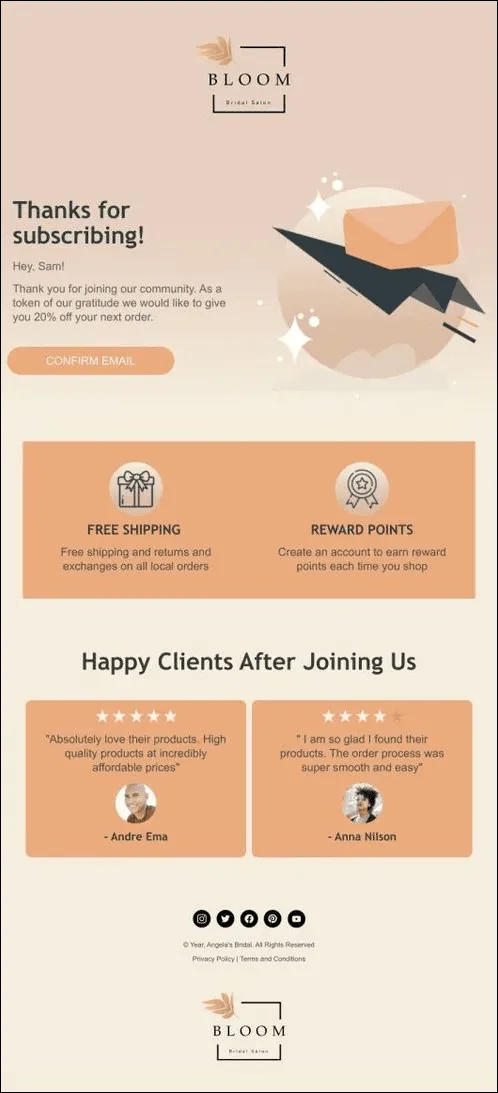
Bloom welcomes new subscribers with a warm, personalized message and a 20% incentive on the next order, which immediately reframes the relationship as a value exchange rather than a simple sign-up confirmation. The inclusion of two customer testimonials at this early stage is a subtle but powerful trust signal.
Why does this email work?
- It secures the deliverability of the email via a clear confirmation CTA.
- It introduces long-term retention mechanics like free shipping and reward points before the customer has even placed an order. The subscriber’s mindset shifts from “one-time discount hunter” to “future/loyal customer.”
- The layout is clean and uncluttered, the messaging is focused, and the visual hierarchy guides the eye cleanly from incentive to trust to action.
2. Everlane
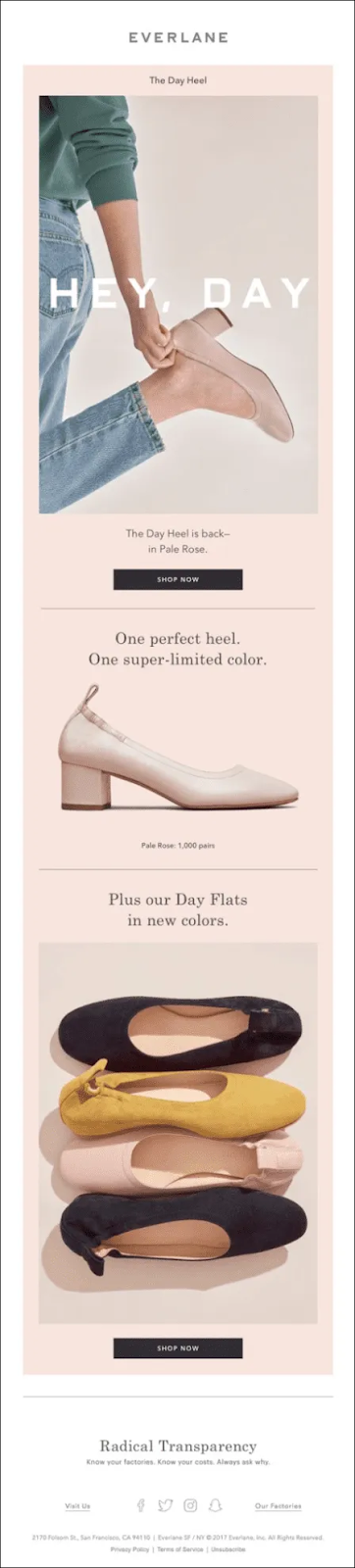
Everlane centers this campaign around a single hero product – the Day Heel – in a limited-edition Pale Rose colorway. This way, the email has a focused product drop rather than a broad promotion. The framing looks intentional – focused on just the product with shade and a clear purpose.
By calling out the exact quantity available (1,000 pairs), Everlane transforms availability into a psychological trigger rather than a sales gimmick. This email lets you know that your favorite item is back in stock, so it’ll make you want to buy it even more.
Why does this email work?
- It creates urgency through inventory transparency instead of price reduction, which protects brand equity while still driving immediate action.
- It simplifies the decision-making path by eliminating choice overload and directing all attention toward a single conversion objective.
- It increases potential order value by introducing Day Flats as a natural secondary purchase without diverting focus from the primary offer.
- It uses oversized product imagery and restrained copy to let visual merchandising perform the persuasion, reducing cognitive friction.
3. Care/of Frames
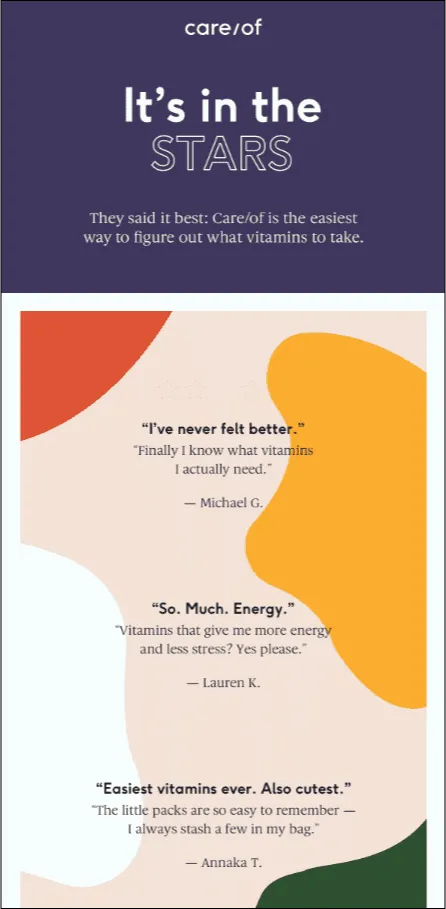
Care/of frames this campaign around social proof as the core conversion lever, positioning real customer outcomes as the primary reason to engage with the brand. Rather than leading with product features or formulations, the email opens with validation from existing users. This gives them immediate credibility for a highly trust-sensitive category.
The headline “It’s in the Stars” supports the brand’s email personalization promise while keeping the message emotionally driven rather than medically technical.
Why does this email work?
- It reduces perceived risk by front-loading real customer outcomes before asking for any commitment.
- It shifts the decision lens from “Do I need vitamins?” to “People like me are seeing results,” which accelerates consideration in a crowded wellness market.
- It uses short, benefit-driven testimonials to communicate multiple value angles, energy, ease of use, and daily habit formation, without overwhelming the reader.
- It keeps the visual layout minimal, which gives the testimonials a chance to function as the primary persuasion asset instead of relying on aggressive CTAs.
4. Fleur & Bee
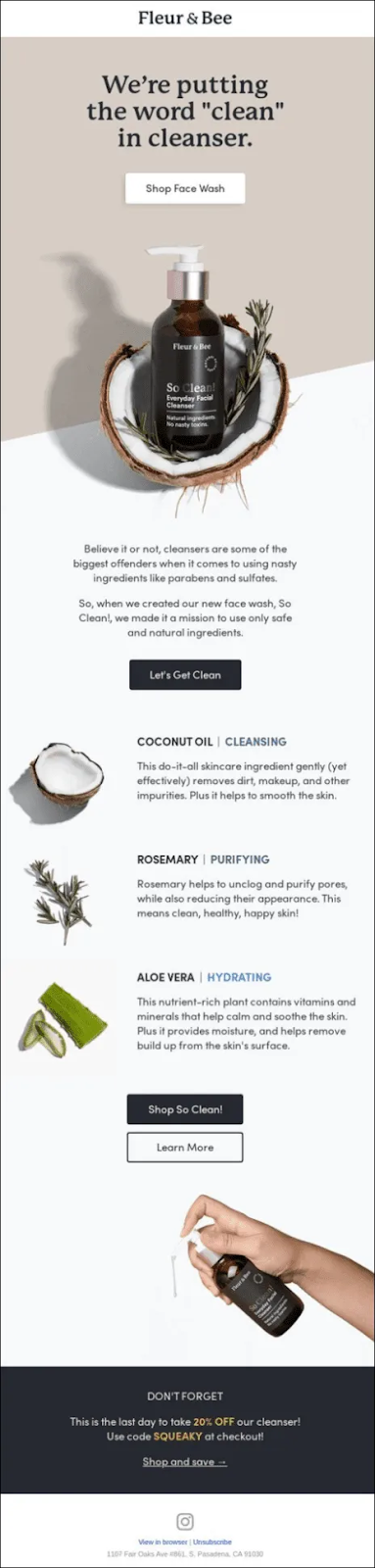
Fleur & Bee positions this campaign around a single, high-intent product and anchors the narrative in ingredient transparency and skin safety. The headline immediately reframes a common skincare concern, i.e., harsh cleansers, into a clear product promise, while the visual treatment keeps the focus tightly on the bottle, the formula, and the natural components that support the claim.
Why does this email work?
- It leads with a sharp, benefit-driven hook that speaks directly to ingredient-conscious buyers before presenting the offer.
- It reinforces credibility through visual ingredient cues that align with the brand’s “clean” positioning rather than relying on abstract claims.
- It introduces urgency only after the value has been fully established. It used a time-bound discount as a secondary push rather than the primary driver.
- It maintains a clean, vertical visual hierarchy that moves the reader from promise to proof to action without cognitive overload.
5. Lowellita
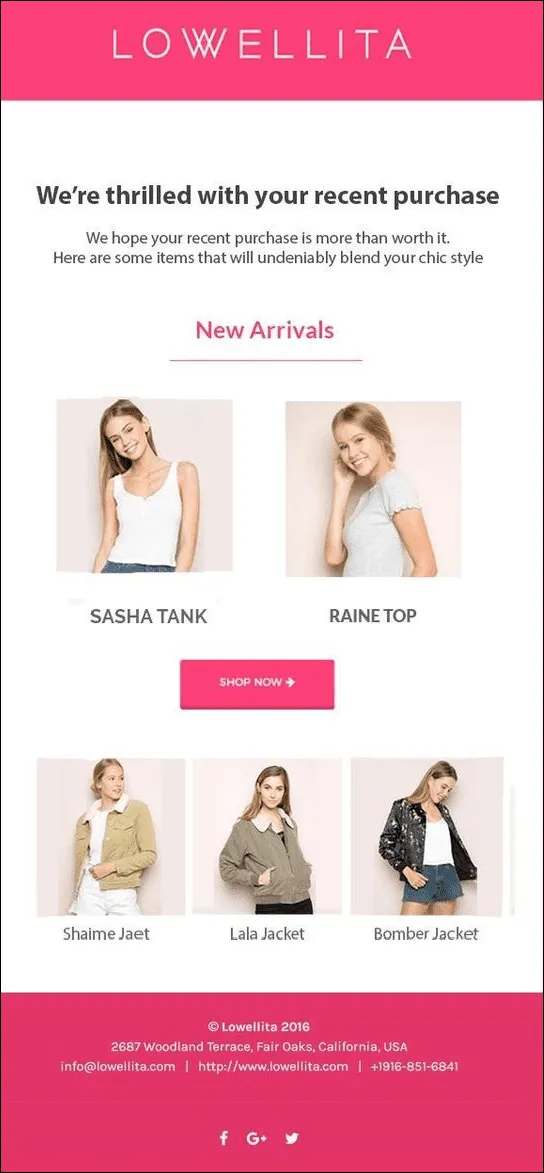
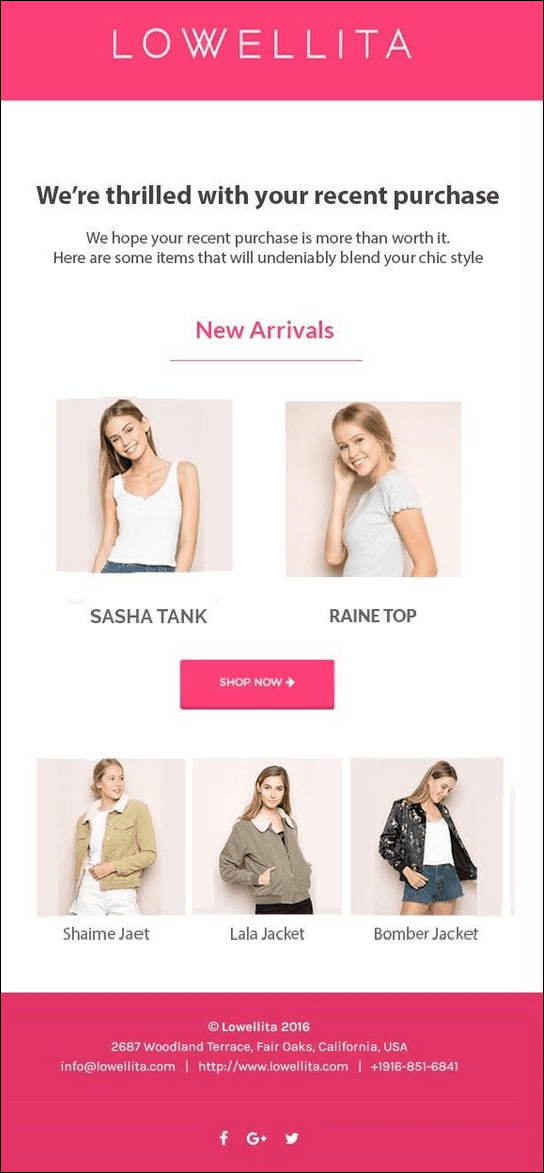
Lowellita capitalizes on recent purchase momentum by positioning product discovery as a natural next step rather than a cold upsell email. The opening line acknowledges the transaction first, which frames the email as service-driven before it becomes promotional.
They added a selection of “New Arrivals,” so now, the brand has shifted the context from selling to styling, which feels additive to the customer’s existing choice.
Why does this email work?
- It extends the customer lifecycle immediately after conversion, which is when engagement and intent are still heightened.
- It uses post-purchase psychology by reinforcing decision confidence before introducing complementary products.
- The visual grid format reduces cognitive load by keeping attention on product variety rather than copy.
- The single, high-contrast “Shop Now” CTA concentrates all momentum into one clear action.
6. Birchbox
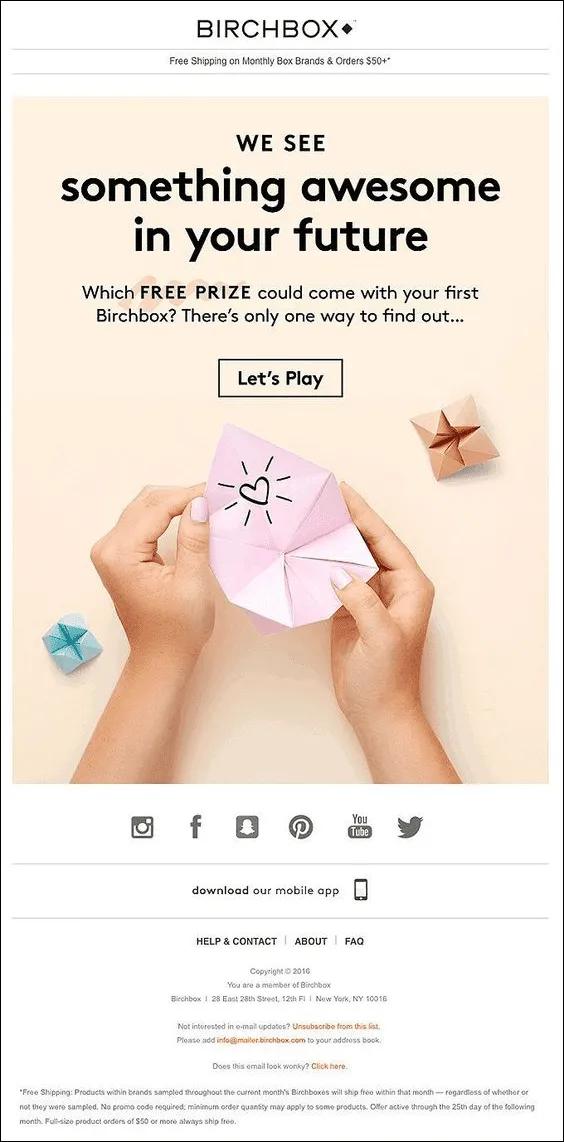
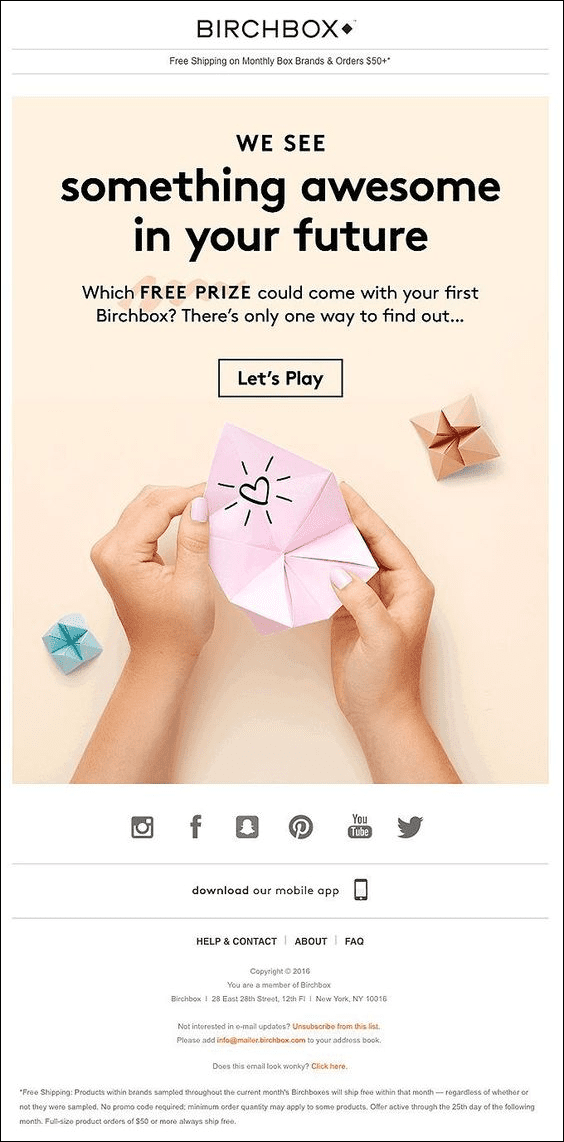
Birchbox frames the promotion as an experience rather than just a discount. It is inviting the subscriber to “play” for a free prize tied to their first box. The messaging centers on curiosity and future reward instead of price, which positions the brand as discovery-led rather than deal-driven. You must also add a subject line (to add curiosity), so atleast your email is opened. The interactive fortune-teller visual reinforces the idea of surprise, which aligns directly with the core value proposition of the subscription itself.
Why does this email work?
- It uses gamification to its advantage to increase click intent without relying on monetary incentives.
- It shifts the customer’s focus from cost to anticipation, which strengthens perceived value before the first conversion.
- The CTA uses action-based language like “Let’s Play” that lowers psychological resistance compared to a transactional “Buy Now.”
- The single-offer layout removes any kind of distraction and channels all attention toward one thing. The email focuses on discovery while simultaneously nudging the subscriber closer to activation.
7. Loeffler Randall
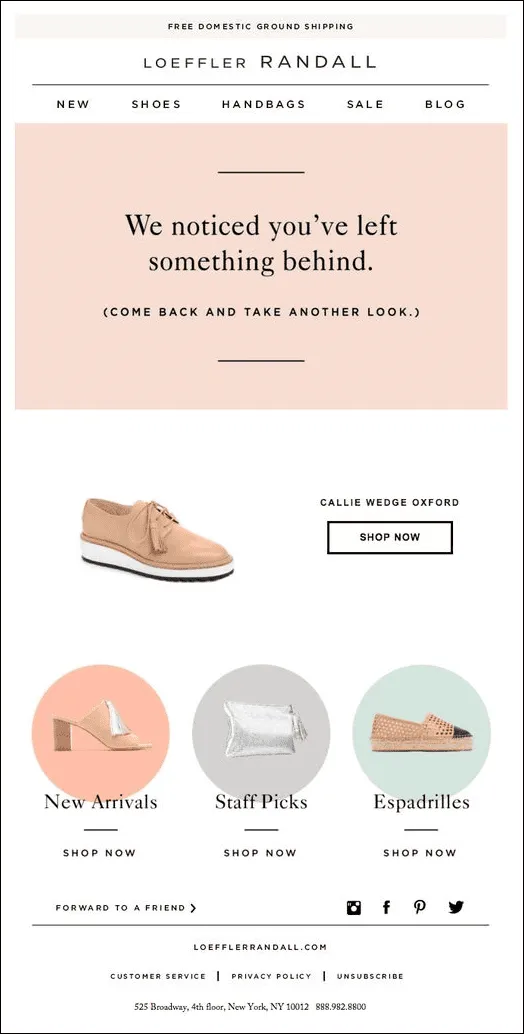
Loeffler Randall uses a restrained abandoned-browse reminder that prioritizes brand tone over pressure tactics. The headline acknowledges the lapse without introducing urgency or incentives. By resurfacing the exact product alongside adjacent shopping paths like “New Arrivals” and “Staff Picks,” the email widens the re-entry point without derailing original intent. Remember, these abandoned cart emails’ first goal is to re-engage with customers rather than pushing them to buy from you immediately.
Why does this email work?
- This email capitalizes on high-intent behavior without diluting margin through discounts.
- It relies on memory refresh rather than persuasion, which is effective when it comes to abandoned cart emails.
- The single hero product anchors relevance, while secondary navigation options capture shoppers who are still in exploration mode.
- The visual calm reduces decision fatigue and keeps focus on the product. It reactivates interest through familiarity and ease, not urgency or promotional pressure.
8. Anniversary Email
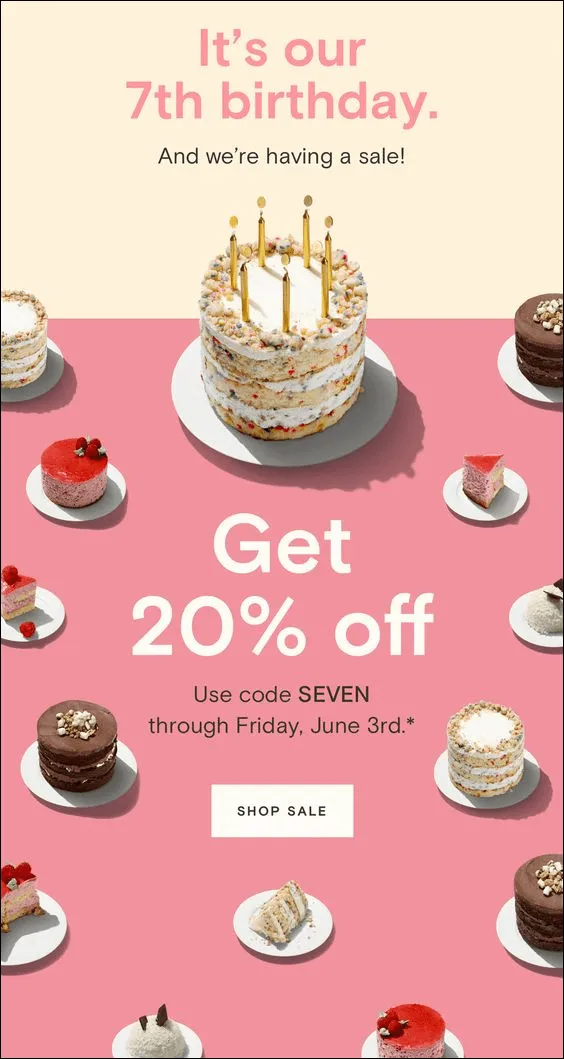
This anniversary email turns a brand milestone into a shared celebration, unlike the regular sales push. The visual language leads with emotion first; it could be a birthday, a cake, candles, before introducing the discount, which frames the offer as a gift instead of a promotion. The 20% incentive feels earned through the story of longevity rather than triggered by urgency alone.
Why does this email work?
- This email anchors the discount to an identity moment rather than a pricing tactic, which protects brand equity while still driving conversion.
- It leverages temporal relevance by tying the offer to a specific occasion instead of an arbitrary sale window.
- The centralized hero visual creates instant thematic clarity, while the surrounding product layout subtly signals assortment depth without overwhelming the offer.
- The code and deadline appear only after emotional context is established, which keeps the discount from feeling transactional.
9. Office Mail
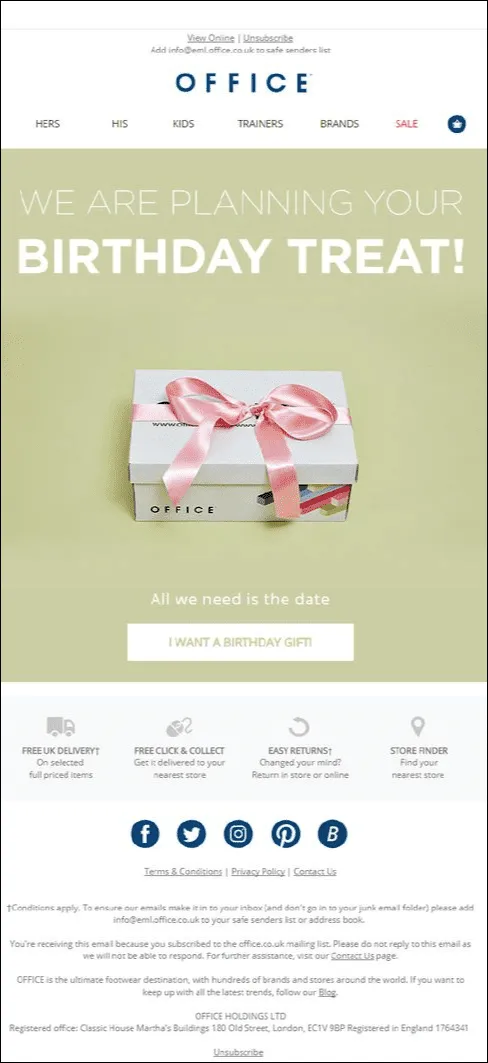
The previous email is also a birthday email, but the brand’s birthday. This one, on the other hand, frames the request for a birth date as a personalized gift rather than a marketing preference update. The promise of a “birthday treat” positions the brand as proactive and thoughtful, not transactional. The visual of a wrapped gift reinforces the emotional cue before any commercial intent is introduced.
Why does this email work?
- This email uses psychological reciprocity to secure high-quality first-party data without friction.
- It aligns data collection with a clear consumer benefit, which increases opt-in likelihood and long-term engagement potential.
- The CTA language focuses on receiving rather than giving, which shifts perceived effort away from the subscriber.
- The design remains minimal to keep attention on a single action. It quietly strengthens lifecycle marketing capabilities and maintains a customer-first experience.
10. Vitamin Sale Email (Seasonal Discount)
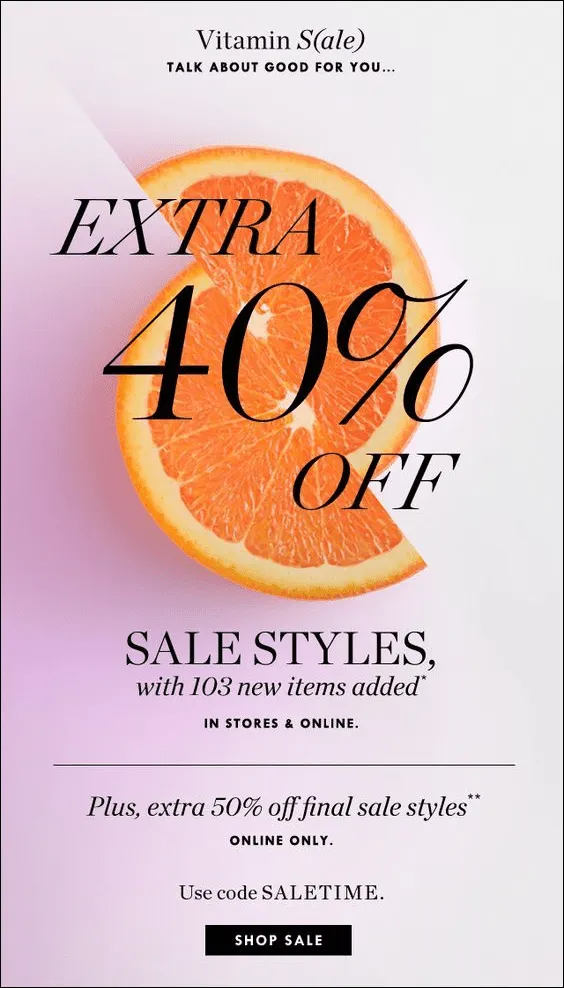
This promotional email campaign positions a high-value discount as an energizing seasonal event. The playful headline “Vitamin S(ale)” puts a fun pun in the mail. It reframes the offer as something rewarding, supported by a bright citrus visual that signals freshness and momentum. The oversized 40% Off anchors attention immediately, while the highlight of 103 new items added expands appeal and drives browsing intent. The additional 50% off final sale styles strengthens the depth for deal-focused shoppers. A centered CTA and time-bound code maintain commercial clarity without crowding the layout.
Why does this email work?
- It transforms a discount message into a feel-good, benefit-led moment that elevates perception.
- It layers incentives to capture different buyer motivations, and it does it without overwhelming the reader.
- It uses bold, upward visual energy that mirrors the emotional tone of the offer.
- It drives urgency through timing language rather than pressure tactics.
11. Loeffler Randall – Sweepstakes Promotional Email
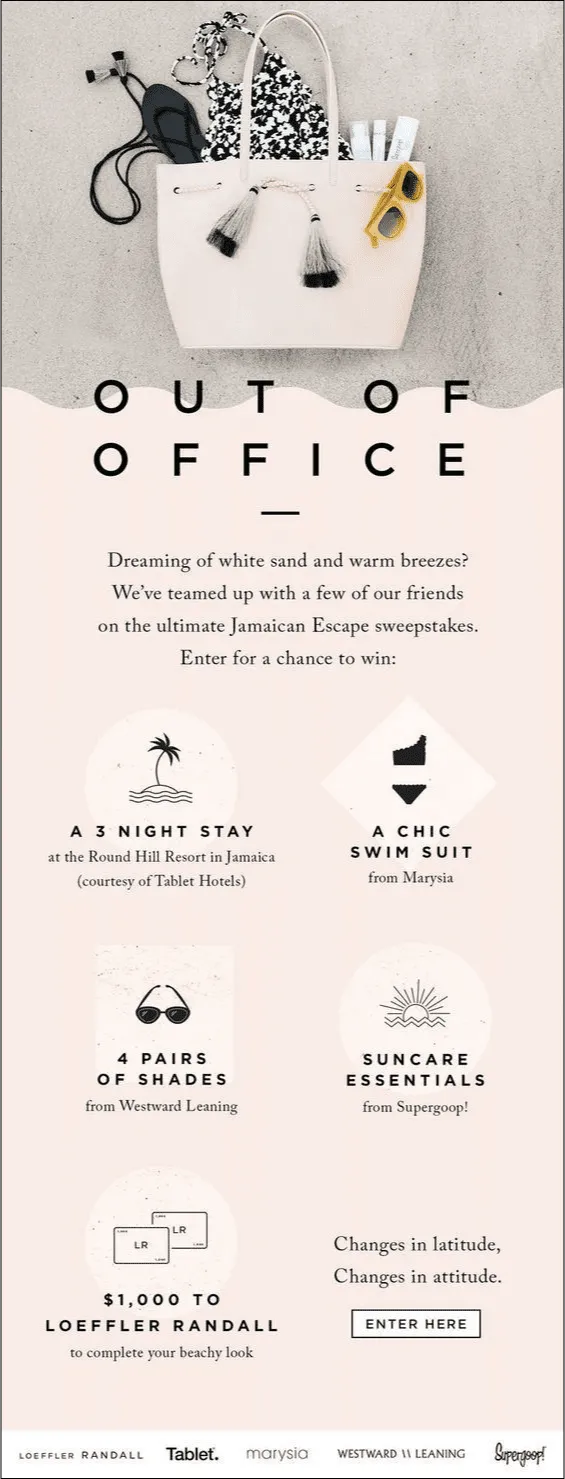
This campaign takes a completely different approach from Loeffler Randall’s previous abandoned cart mail. That email relied on subtle re-engagement and product resurfacing. Instead of nudging a shopper back to a previously viewed item, this promotional email creates an aspirational escape designed to spark excitement and participation. The headline “Out of Office” shifts emotional state immediately, inviting the reader into a dream-worthy travel scenario before presenting any promotional structure. The stacked prize lineup positions the sweepstakes as a high-value experience rather than a standard offer.
Why does this email work?
- It reframes promotion as an aspirational lifestyle experience, which increases engagement even among low-intent subscribers.
- It uses a sweepstakes strategy to drive audience growth and first-party data capture without discounting core products.
- It streamlines the conversion path through a single CTA that channels momentum toward one measurable action.
12. Groundhog Day
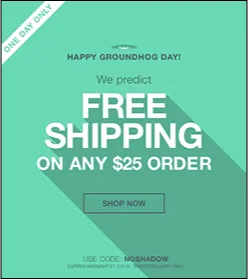
This promotional email has used a novelty holiday to introduce a limited-time offer, using Groundhog Day as a fun seasonal excuse to drive quick conversions. Brands send emails like this to activate urgency, increase short-term revenue, and re-engage passive subscribers through a low-resistance incentive such as free shipping.
Why does this email work?
- It turns a non-commercial holiday into a promotional opportunity, allowing the brand to stand out in the inbox when competition is low. Most brands overlook dates like Groundhog Day, so tying an offer to an unexpected theme increases novelty.
- It uses free shipping as a psychological threshold remover, reducing price friction for customers who hesitate over smaller purchases.
- It applies urgency through a one-day expiration, which accelerates decision-making and captures impulse behavior.
- It maintains a singular focus on the CTA. When only one action exists, the probability of completion rises significantly.
13. Countdown Urgency
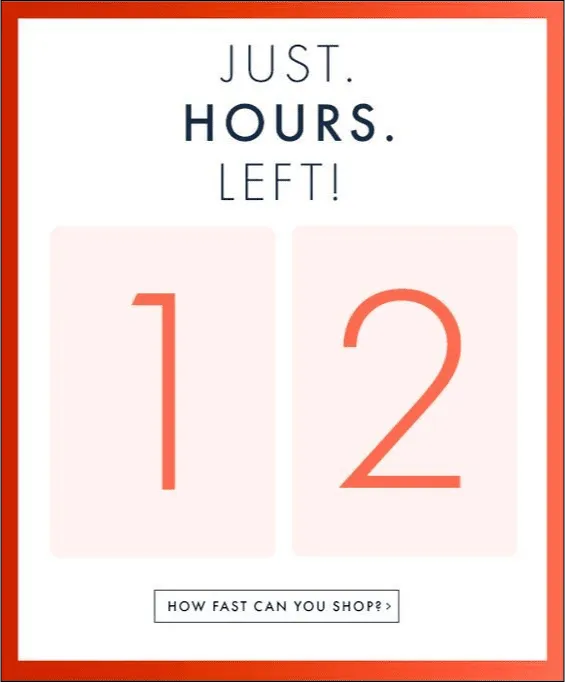
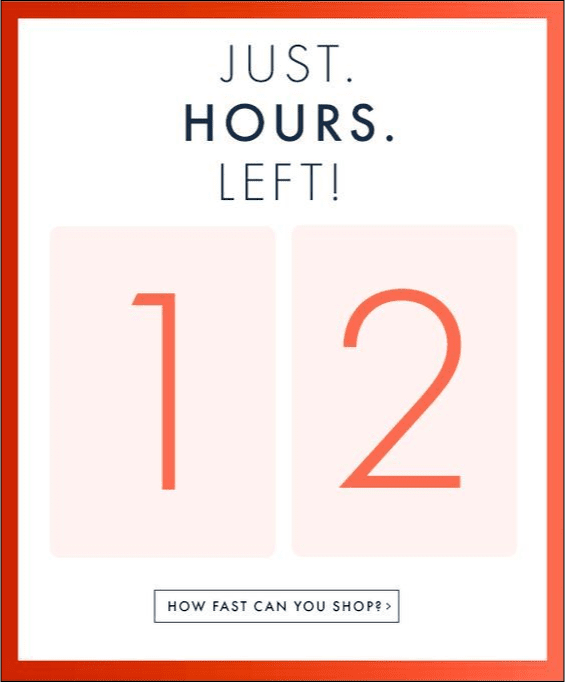
This is a last-chance countdown email built to activate urgency, usually at the end of a promotional window. Brands send emails like this to capture fence-sitters and hopefully recover revenue from shoppers who showed interest but never completed a purchase. You must focus on the email marketing KPI’s you can track, like conversion rates, CTRs, and revenue per send, and you’ll know if the urgency is driving action or simply adding pressure.
Why does this email work?
- It uses time pressure as the central motivator, which shifts the shopper’s mindset from browsing to deciding.
- It removes unnecessary messaging and focuses attention on urgency, creating a faster path to conversion.
- It reaches high-intent customers who have already considered purchasing, increasing the likelihood of conversion without additional incentives. These shoppers respond strongly to deadline-driven reminders.
- It employs challenge-based language that energizes the decision, framing the moment as action-oriented.
14. Quip
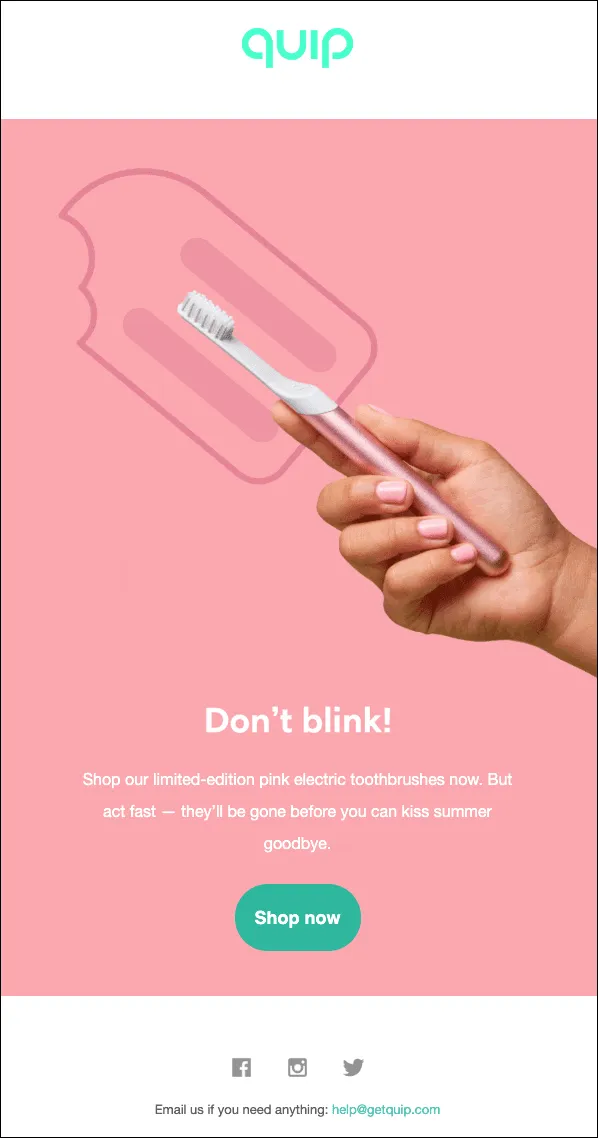
This is a limited-edition product drop that is actually a seasonal variation of the brand’s hero product, and this email is intended to create urgency and drive immediate sales. Brands send emails like this to spark impulse buying and generate fast revenue from customers who respond to exclusivity messaging.
Why does this email work?
- It positions the product as temporarily available, so the urgency reaches the audience. Shoppers act faster when they believe a product will disappear.
- It focuses attention on a single item instead of a full collection, simplifying the decision process and reducing choice paralysis. One clear offer drives faster conversions.
- It uses energetic, time-sensitive language, which shifts the mindset from browsing to securing the item before it sells out. Urgency-driven phrasing consistently improves click intent.
- It targets existing customers who already know the brand value, which makes this particular message more efficient because they don’t need to be educated or persuaded from scratch.
15. Educational Content Promotion
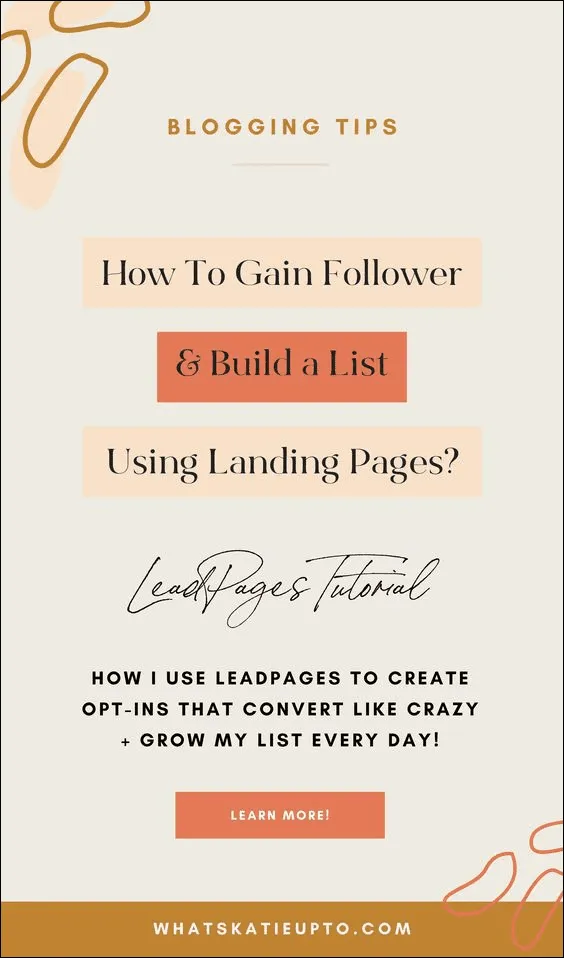
This promotional email is focused on driving traffic to educational content designed to nurture subscribers and move them closer to a conversion. Brands send emails like this to build trust. It also positions them as experts and warms up an audience before pitching a paid product or service.
Why does this email work?
- It delivers value first through education, which increases authority and strengthens the relationship before any sales request. Subscribers generally respond strongly when a brand teaches them something useful instead of selling something always.
- It positions the tutorial as a shortcut to results, which increases perceived usefulness and encourages engagement from readers seeking growth or improvement.
- It taps into the pain points around audience growth and list building, which increases relevance and drives higher click intent.
- It establishes a lead-generation pathway by directing readers to gated educational content, which helps capture qualified leads ready for deeper offers later.
16.
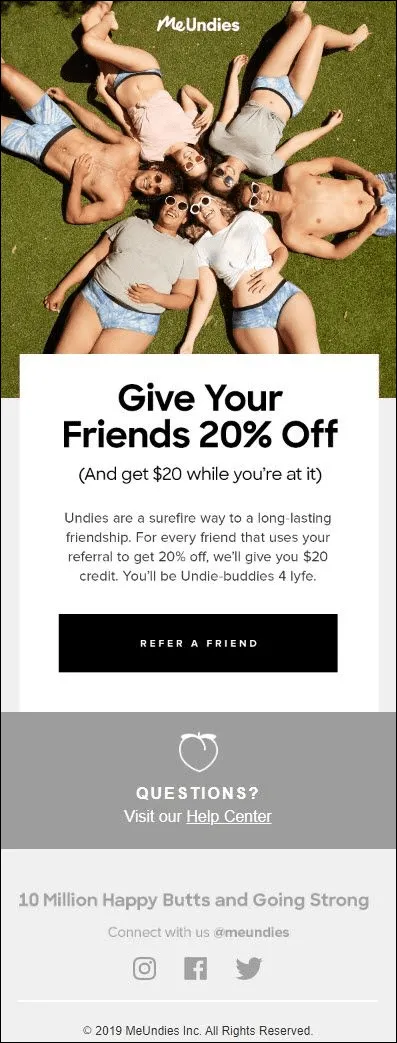
This is a referral promotion, and its goal is to turn existing customers into acquisition drivers by rewarding both the advocate and the referred friend. Brands send emails like this to scale growth through word-of-mouth, lower customer-acquisition cost, and build loyalty through shared incentives.
Why does this email work?
- It positions referral as a mutual win, which increases participation since customers feel they are giving value. Shared rewards strengthen social motivation and increase the likelihood of referral behavior.
- It activates community identity, which reinforces emotional connection to the brand. When customers feel part of a group, they become more willing to advocate and spread the message.
- It turns customers into marketing channels without additional spend, which raises customer lifetime value and reduces dependency on paid advertising. Referral programs consistently drive strong-quality leads because they come with built-in trust.
- It uses a direct CTA focused on immediate action, which shortens the path between intent and behavior. The single call to “Refer a Friend” keeps the experience simple and increases follow-through rate.
17.
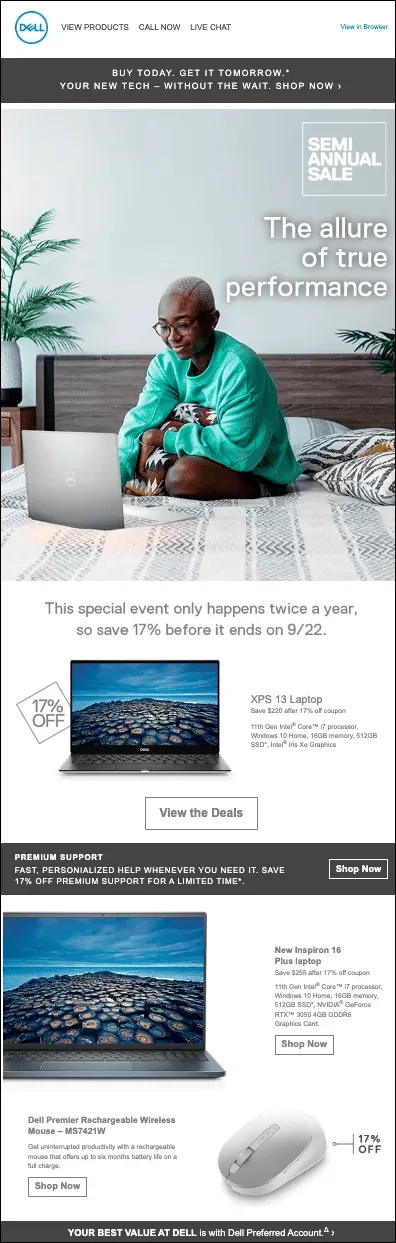
This is a major sales-event email built to drive high-value seasonal purchases and increase revenue during a predictable promotional cycle. Brands send emails like this to maximize demand during peak buying windows. It is a win for shoppers who wait for the best deal before upgrading tech.
Why does this email work?
- It anchors the sale around scarcity tied to timing, which increases urgency because the event only happens twice a year. Customers perceive more value when a discount window feels rare.
- It highlights a clear percentage savings upfront, which simplifies evaluation and accelerates decision-making for higher-ticket products. When you provide clarity during expensive purchases, it works in your favor.
- It segments attention across multiple product tiers, which increases the chance of matching intent across different budgets.
18.
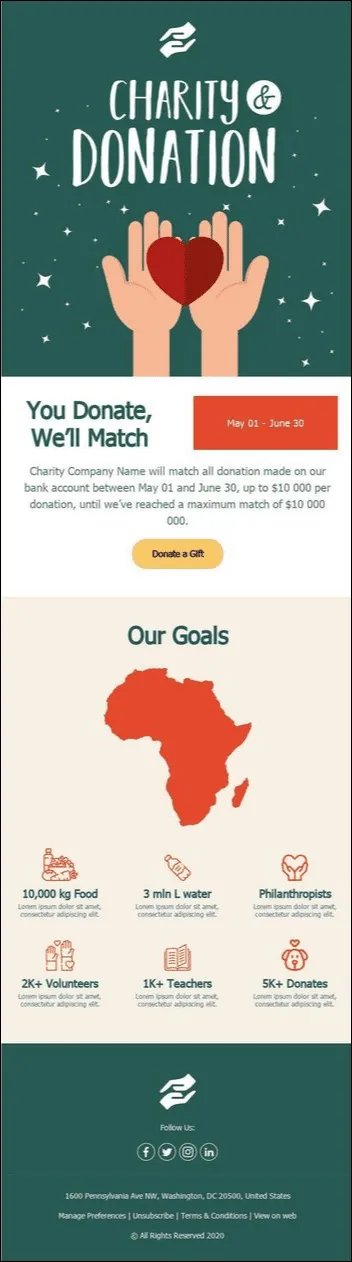
This is a donation-match campaign created to increase contribution volume by offering an incentive during a defined period. Brands send emails like this to drive social impact participation, activate emotional engagement, and strengthen brand values through purpose-led communication. Remember, customers stay engaged when there is variety too, so mix such promotional emails with simple newsletters to keep them interested.
Why does this email work?
- It introduces financial matching as a motivating mechanism, which increases donation likelihood because contributions feel amplified.
- It uses a clear deadline window, which encourages immediate participation instead of delayed intent. Time-bound philanthropy produces stronger response curves.
- It connects the request to tangible outcome metrics, which increases trust and accountability. Donors want to see how contributions translate into real change.
- It communicates purpose-based identity, which builds loyalty and deepens emotional connection.
19. ClassPass
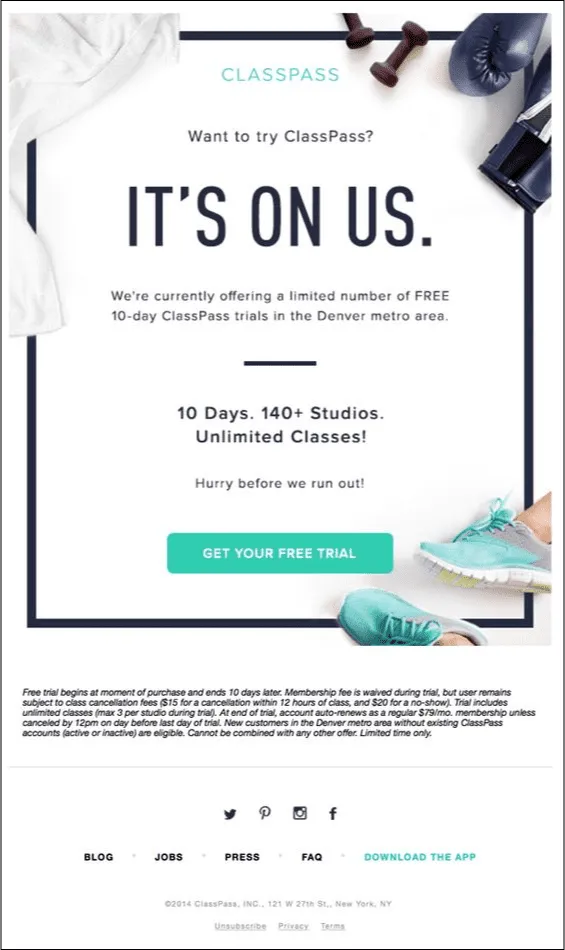
This is a free-trial promotional email designed to remove financial hesitation and convert curious prospects into active users through a risk-free entry point. Brands send emails like this to increase trial activation, accelerate product adoption, and build habit loops that lead to paid subscriptions.
Why does this email work?
- It eliminates the cost barrier, which reduces perceived risk and increases participation from prospects who hesitate to commit. Free trials are effective at turning consideration into action.
- It sets a clear urgency message tied to limited availability, which encourages faster decision-making. Scarcity increases the likelihood that prospects act instead of delaying the choice.
- It emphasizes a high-value offer with quantified benefits, which strengthens perceived worth. Access to 10 days, 140+ studios, and unlimited classes signals abundance and makes the trial feel worth it.
- It targets regional relevance, which increases response rate since localized offers feel more exclusive and tailored.
20.

This is a welcome and product-introduction email created to orient new subscribers, reinforce brand philosophy, and guide them toward exploring the full product range. Brands send emails like this to build long-term affinity. These types of emails are also used to increase first-purchase likelihood and educate new subscribers on what sets their brand apart.
Why does this email work?
- It uses purpose-led onboarding to shape brand perception, which establishes an emotional connection early in the customer journey. This way, the emails seem less transactional and more value-driven.
- It positions products as tools that support personal transformation, which reframes items as solutions rather than commodities.
- It introduces clear category pathways, which simplify browsing and reduce overwhelm for new subscribers. Structured product segmentation increases the chance of matching intent and encourages deeper exploration.
- It nurtures first-purchase momentum by blending education with subtle promotion, which builds trust.
21. Polaroid
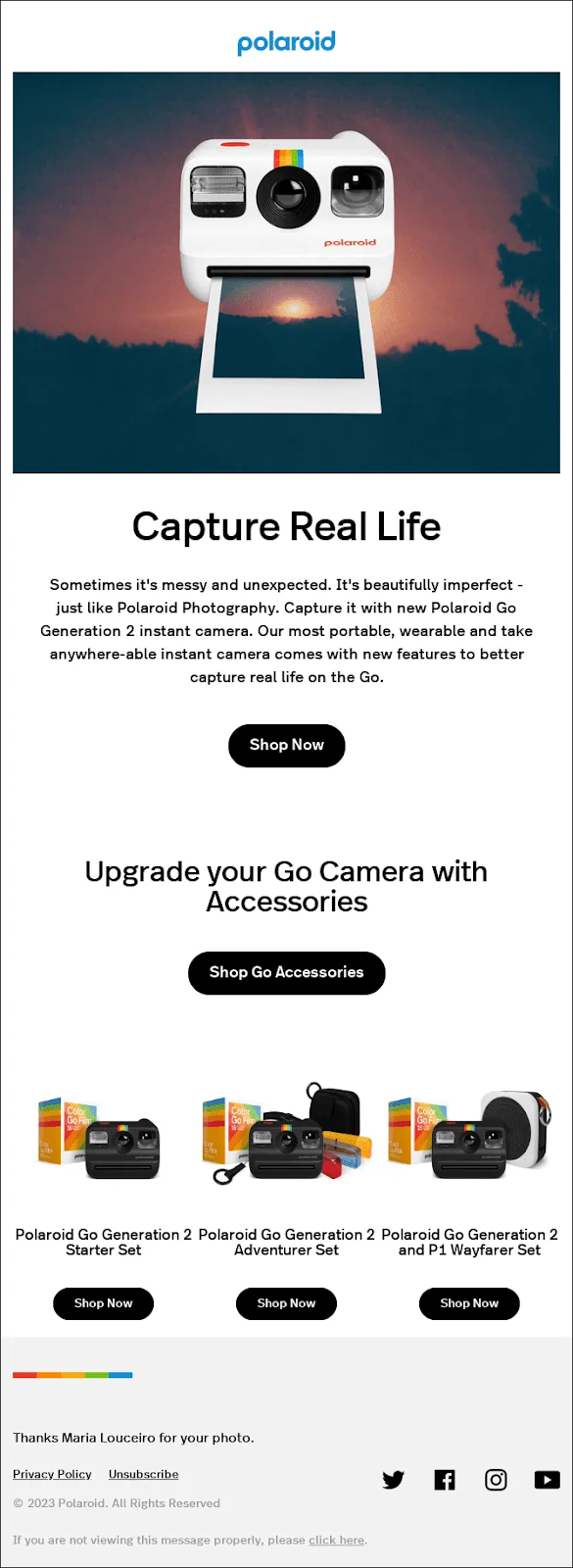
This is a product-launch promotional email created to introduce a new version of a flagship item and drive immediate purchase interest. Brands send campaigns like this to showcase innovation, increase excitement around a fresh release, and activate cross-sell opportunities through bundled accessories.
Why does this email work?
- It positions the new product around an emotional experience, which shifts attention from features to lifestyle identity.
- It introduces the launch with a single clear call to action, which eliminates distraction and increases conversion efficiency. A focused CTA guides shoppers directly to the product page instead of sending them into broad catalog exploration.
- It opens additional revenue pathways through accessory bundles, which increase order value and simplify decision-making.
- It reinforces credibility by highlighting improvement and new capabilities, which support rational justification for replacing or upgrading gear. Customers often need clear improvement signals before committing to tech products.
22. Pelago
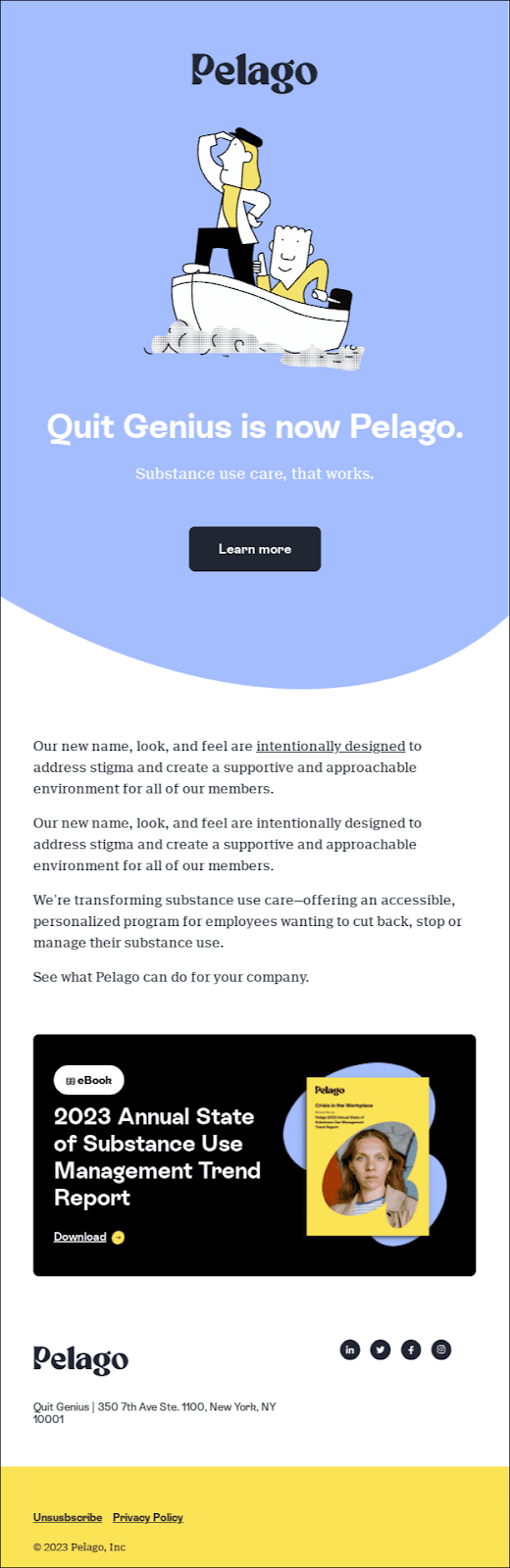
This is a rebrand announcement email created to communicate a name and identity change while reinforcing mission alignment and continuity of service. Brands send emails like this to maintain trust and prevent any confusion. It also reintroduces their value proposition under a refreshed positioning.
Why does this email work?
- It addresses potential uncertainty directly, which helps preserve confidence among existing customers during a transition. Rebrand messages must clarify purpose to avoid hesitation or concern.
- It focuses on mission-based reasoning rather than cosmetic change, which strengthens emotional loyalty and positions the shift as progress. Subscribers respond more positively when a rebrand ties to meaningful improvement.
- It links the announcement to a tangible resource, which reinforces thought leadership and encourages engagement beyond the update.
- It sets clear expectations about the service continuity, which reduces friction for current users and protects retention at a critical moment.
23. TripAdvisor
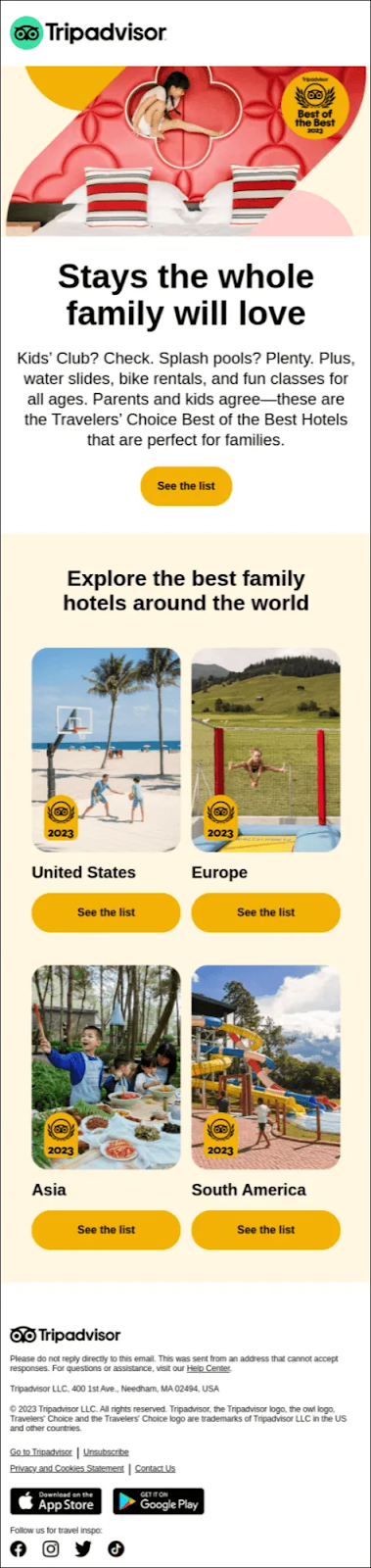
This is a curated recommendation promotional email designed to guide subscribers toward a targeted list of top destinations and hotels. Only those who have given permission will receive it. Brands send emails like this to increase booking intent and position themselves as trusted “trip” advisors rather than price-driven sellers.
Why does this email work?
- It uses social proof as the central persuasion driver. Recognition from a credible community lowers perceived risk and influences unfamiliar purchase decisions.
- It organizes recommendations by region, which simplifies exploration and supports faster decision pathways. Clear segmentation increases engagement because readers can jump directly to locations aligned with their interests.
- It focuses the offer around family-specific needs, which targets a certain kind of audience and strengthens relevance. Targeted framing consistently outperforms broad messaging because it speaks directly to the buyer’s motivations.
- It prioritizes discovery over discounting, which supports long-term brand authority. When value comes from expert curation, the brand becomes a planning partner instead of a transactional platform.
24. Methodical Coffee

This email design is an order confirmation and fulfillment-tracking design to provide transparency after purchase while opening the door for additional sales. Brands send this type of campaign to reinforce confidence, reduce post-purchase anxiety, and introduce cross-sell suggestions while excitement is high.
Why does this email work?
- It strengthens trust by providing detailed order status and tracking information, which reduces uncertainty and improves customer satisfaction. Post-purchase clarity plays a major role in repeat buying behavior.
- It introduces personalized product recommendations at a moment when engagement is highest, increasing the likelihood of an add-on order. Customers are most receptive to suggestions immediately after committing to a purchase.
- It positions cross-sells as helpful context rather than aggressive upsell, which maintains positive sentiment.
- It keeps the customer connected to the brand experience beyond checkout, thus building a stronger relationship that supports retention and subscription potential.
25. Maeve
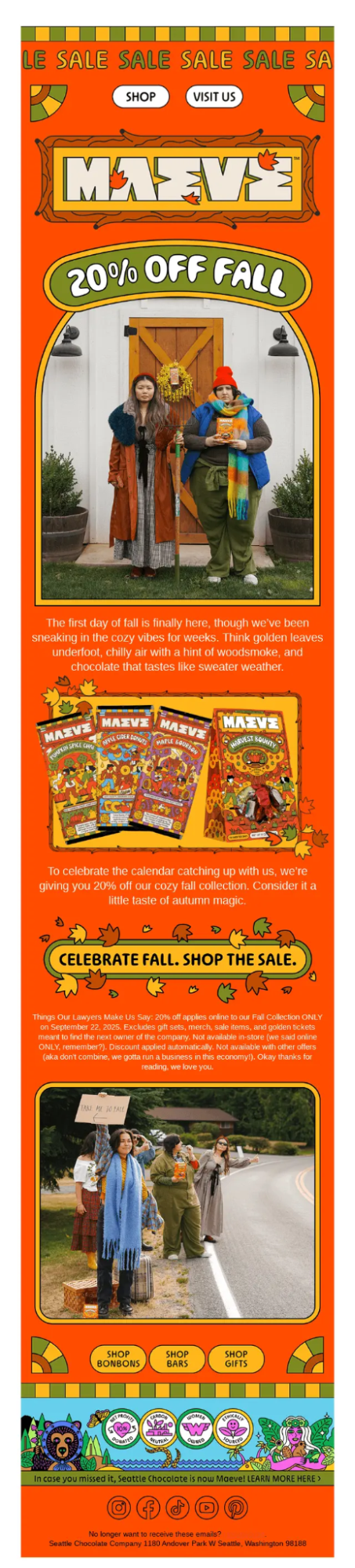
This is a seasonal promotion email positioned around the first day of fall, designed to drive traffic and revenue through a limited-time 20% discount tied to a timely cultural moment. These emails boost engagement during predictable demand spikes and are good to send to people who have abandoned their carts. So, segment your audience accordingly before sending these emails.
Why does this email work?
- It anchors the promotion to a seasonal shift, which creates relevance and emotional resonance.
- It uses strong brand personality and playful copy, which builds affinity and differentiates the message from generic discount blasts.
- It frames the offer around celebration rather than urgency, which keeps the tone warm and community-oriented. Such emails feel like joining a moment instead of being salesy.
- It introduces multiple shopping paths, which increases conversion opportunities by letting customers choose based on interest rather than forcing a single direction.
26. Benjamin Moore
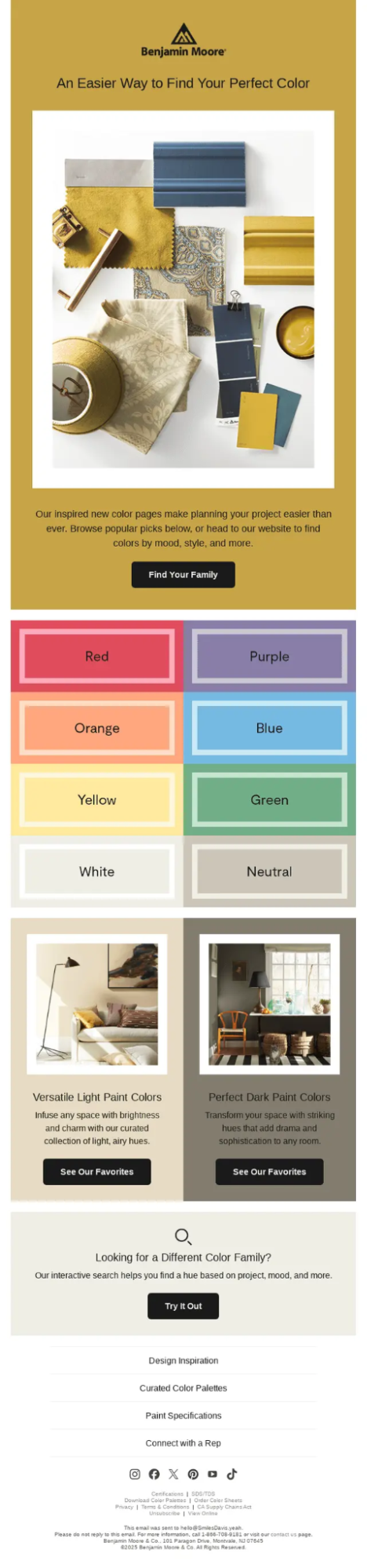
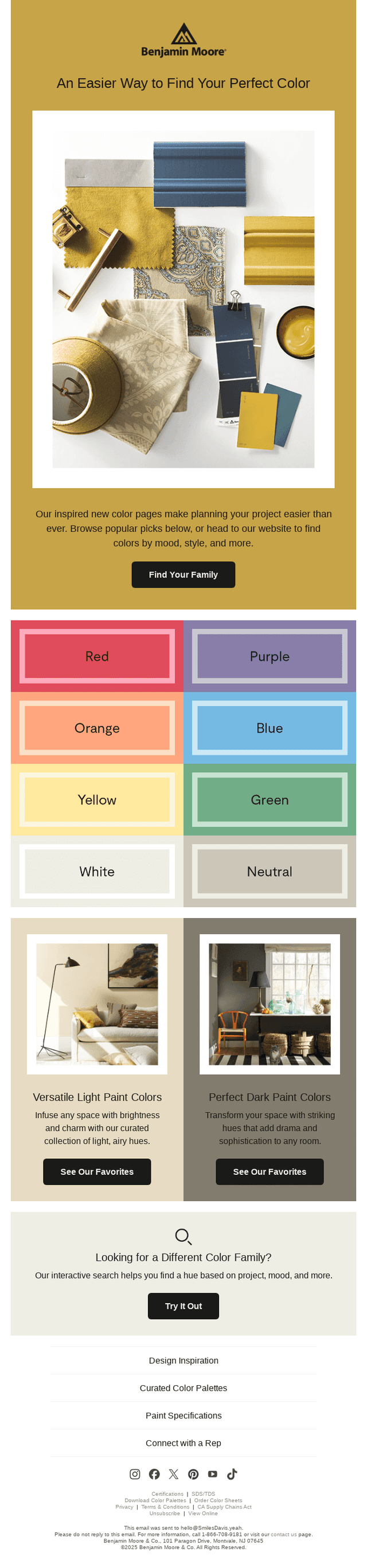
This is a guided product discovery email created to simplify decision-making and guide customers to select paint colors based on curated palettes. Brands send emails like this to move shoppers closer to purchase with structured direction.
Why does this email work?
- It removes choice paralysis by organizing colors into clear categories, which helps customers navigate options confidently.
- It positions the brand as a helpful advisor, building trust through educational guidance instead of aggressive selling. This way, customers feel supported, and conversion happens more naturally.
- It uses multiple access points to deepen engagement, giving subscribers easy paths to explore palettes.
- It keeps the CTA simple and solution-oriented. “Find Your Family” is something you rarely see, so customers feel the urge to explore.
27. Alpinestars
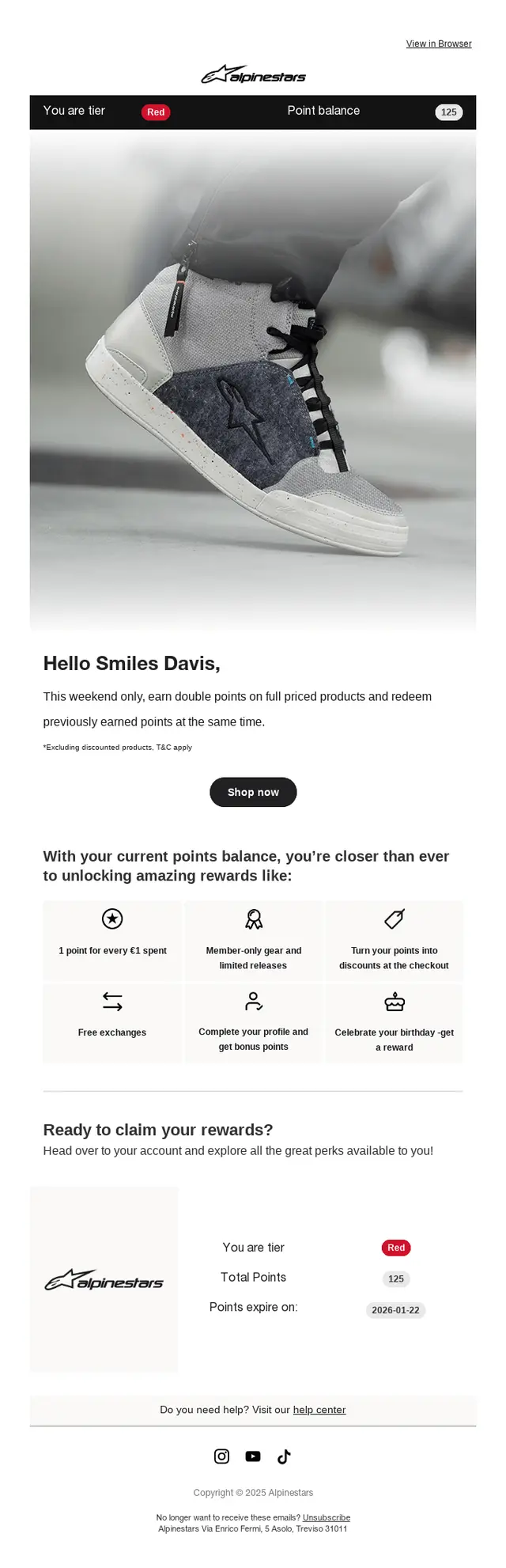
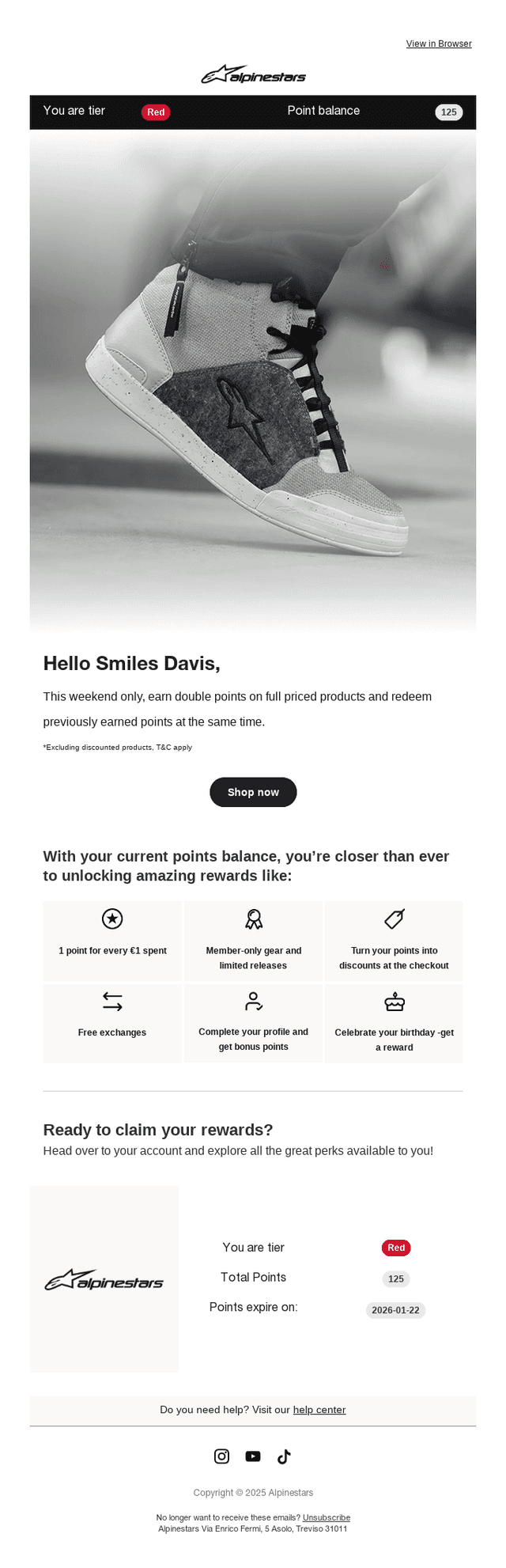
This email nudges members to return and shop by reminding them of their points balance and offering a limited-time double-points boost, and encourages a purchase. It’s a smart way to re-engage customers who are already invested in the brand and close to unlocking rewards.
Why does this email work?
- It feels personal and relevant, using the customer’s point total and tier status right at the top. Seeing progress makes the reward feel within reach, which builds genuine motivation.
- It highlights real perks instead of vague promises, reminding members what they can earn.
- It adds a short-term incentive with the double-points weekend, giving shoppers a reason to act now instead of putting it off.
- It keeps the message friendly and supportive, inviting customers to claim rewards rather than pushing a sale. Tone matters, especially in loyalty communication.
28. ResortPass
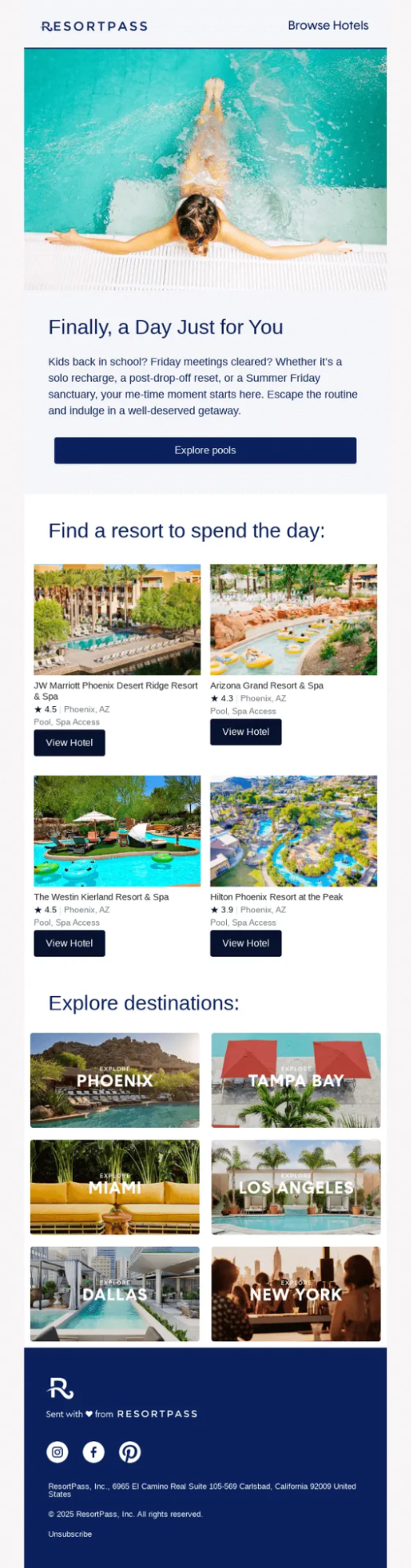
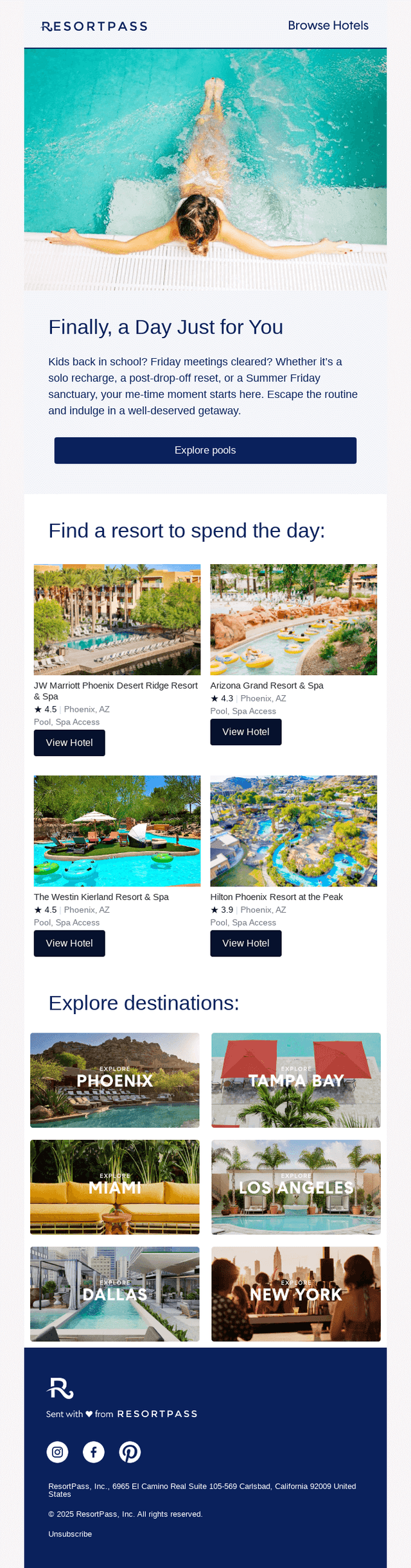
This promotional email encourages subscribers to book a relaxing day pass by tapping into the need for personal downtime (who doesn’t want that). It’s designed to inspire a getaway mindset and convert browsing into bookings through emotional appeal and curated resort options.
Why does this email work?
- It speaks directly to a real-life moment, acknowledging busy schedules and the desire for a break.
- It uses inspiration rather than discounts to motivate action, which keeps the brand positioned as a lifestyle upgrade instead of a bargain-driven option.
- It makes the tedious process of choosing easy by showcasing hotels with ratings and quick-view buttons.
- It encourages exploration by offering multiple destinations, which turns browsing into a fun discovery activity and increases time spent engaging with the content.
29. Verb
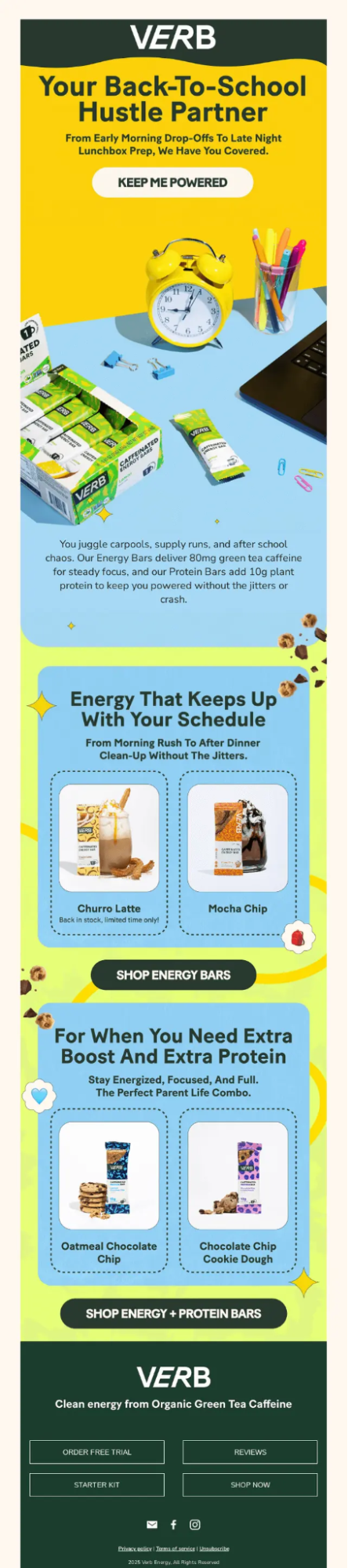
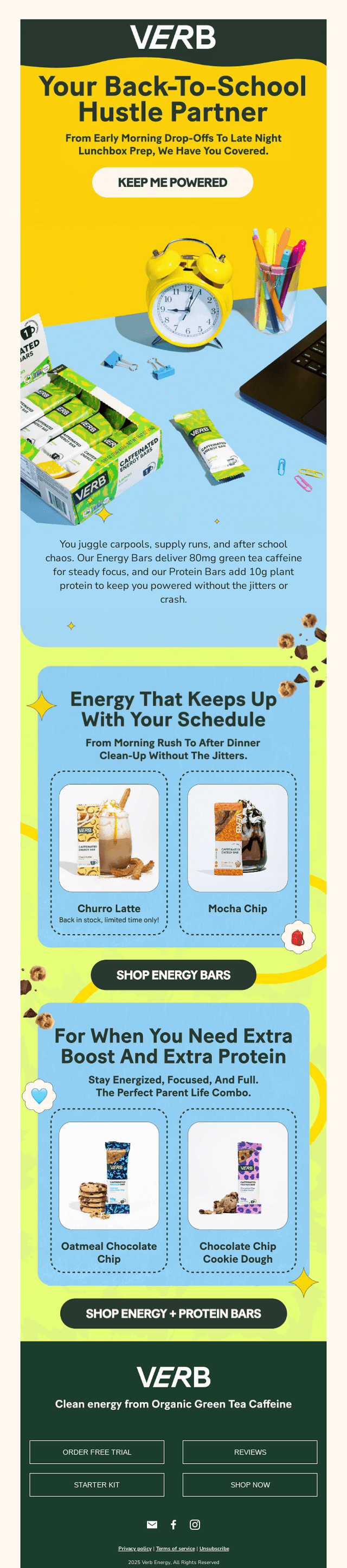
This is a back-to-school themed promotional email that positions Verb bars as an everyday support system for busy routines. It aims to drive purchases by connecting the product to real-life energy needs during a hectic season.
Why does this email work?
- Who doesn’t relate to the chaos of school schedules and nonstop tasks? Speaking to what customers actually experience makes the offer feel useful instead of salesy.
- It connects benefits directly to lifestyle, highlighting steady energy and protein as solutions to real pain points like fatigue and overwhelm.
- It promotes both new and returning flavors, giving shoppers a reason to check what’s fresh while also leaning on familiar favorites.
30. Gozney

This promotional email builds excitement around game day and positions Gozney products as the centerpiece for hosting. Instead of pushing discounts, it sells the entire experience, turning recipes, food inspiration, and community moments into the reason to buy.
Why does this email work?
- It uses game day as the hook. When an email connects to something already on people’s minds, the message lands faster and feels more relevant.
- It focuses on inspiration, not pressure, giving readers recipes and ideas first.
- It moves from free value to product promotion effortlessly, starting with recipes and ending with the pizza dough mix call-to-action. That order builds trust and creates curiosity before introducing the offer.
- It reinforces community and shared experience, reminding readers that good food brings people together.
Conclusion
Promotional emails work best when they feel like an invitation instead of a pitch. They educate, inspire, remind, and encourage, showing up consistently so customers stay connected to your brand. When you balance genuine value with clear offers and smart timing, promotional emails become inbox fillers, and they drive revenue, which helps to strengthen long-term loyalty.
To learn how timing and message cadence influence customer perception, and how promotional emails build brand equity beyond conversions, check out Chapter 5 of our Introduction to Email Marketing Course — The Branding and Strategic Value of Promotional Emails. It explores how promotional campaigns support long-term engagement, customer lifetime value (LTV), and brand positioning.
Use these examples as inspiration to build campaigns that feel human, intentional, and memorable, because great email doesn’t just sell, it builds relationships.
Need help writing or designing emails that actually perform? Partner with an experienced email marketing agency like InboxArmy and get all your answers.