



When teams come to us to talk about Brevo (previously known as Sendinblue), the story is usually the same. They started to use it because it was simple, easy to get live, decent prices, a comprehensive platform, and all of this seemed more than enough…at first.
Then, things change. After thorough research and in-depth testing of email platforms, we see a clear pattern. As programs scale, Brevo starts to feel limiting. Automation gets more complex, and segmentation needs to be more sharpened. Pricing also increases based on the send volume.
At that stage, the question is not “Is Brevo bad?”, the actual question is “Is Brevo still the right fit for where we are now?”
In this guide, we break down the strongest Brevo alternatives we’ve tested, what each one is best at, and when is the best time to switch.
Why You Might Need a Brevo Alternative
Brevo is a strong platform to start with email marketing. However, from research and hands-on testing across multiple ESPs, we came across the fact that most teams typically begin exploring alternatives once they need more advanced automation and pricing that scales without limiting volume. Here are some common reasons for switching:
- Segmentation and personalization depth feel limited
- Testing and workflow changes slow down experimentation
- Pricing increases quickly with higher sending frequency
- Collaboration and workflow management can feel restrictive
- Omnichannel orchestration lacks advanced control
So, let’s look at some Brevo alternatives at a glance
- MailerLite – Best email deliverability and fastest production workflow
- Moosend – Strong automation features at a lower price point
- Omnisend – Built for ecommerce and retail automation
- Klaviyo – Deep personalization and predictive revenue modeling
- ActiveCampaign – Most powerful automation intelligence + CRM alignment
- HubSpot – Complete marketing + sales + CRM ecosystem
- Mailchimp – Wide integrations and advanced design tools
- Constant Contact – Email + social + event promotion workspace
- ConvertKit (Kit) – Best for creators and digital product sellers
- Sender – Advanced automation and segmentation on a budget
The Top Brevo Competitors – An Overview
Before we do a deep dive into the alternatives, here is a comprehensive table
| Platform | Best For | Key Features | Starting Price |
|
MailerLite
|
Deliverability + fast workflow | Automation, landing pages, forms | Free plan; Paid from ~$10/mo |
|
Mailchimp
|
Design control + integrations | Templates, AI tools, multichannel | Free plan; Paid from ₹385/mo |
|
Moosend
|
Automation on a budget | Workflows, landing pages, segmentation | Free trial; Paid from $9/mo |
|
Omnisend
|
Ecommerce & DTC | Email + SMS + push, ecommerce flows | Free plan; Paid from $11.20/mo |
|
Klaviyo
|
Personalization & data depth | Predictive analytics, segmentation | Free plan; Paid from $45/mo |
|
HubSpot
|
All-in-one CRM + automation | Smart CRM, workflows, reporting | Free CRM; Paid modules scale |
|
ActiveCampaign
|
Advanced automation + CRM | Multichannel flows, lead scoring | Paid from $15/mo |
|
Constant Contact
|
Email + social + events | Email, SMS, social scheduling | Paid from $12/mo |
|
Sender
|
Best value for startups | Email + SMS, automation, segmentation | Free (2,500 subs); Paid from $7/mo |
|
ConvertKit (Kit)
|
Creators + digital products | Visual automations, paid newsletters | Free (10,000 subs); Paid from $33/mo |
|
AWeber
|
Simple setup for small teams | Landing pages, ecommerce, support | Free trial; Paid from $12.50/mo |











The Best Brevo Alternatives to Consider
If Brevo starts to feel like it is too limiting, then exploring some alternatives is the logical next step for your email marketing campaigns. The platforms below are not generic replacements; in fact, each one solves a very specific gap Brevo tends to miss. Let’s break them down one at a time –
1. MailerLite
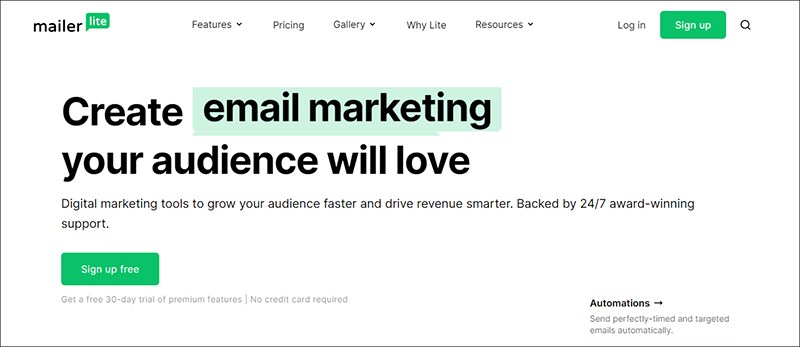
MailerLite is built for teams that want to work fast. The platform keeps things simple and removes unnecessary steps. You log in, create what you need, and move forward without getting stuck in setup or technical details.
Standout Features:
- Drag-and-drop editor that’s clean and easy to use
- Landing pages, pop-ups, and websites built in
- Automation workflows with behavioral triggers
- A/B testing for emails and forms
- Strong deliverability performance in real-world testing
Why choose MailerLite over Brevo
Brevo gets heavier the more you scale. If your priority is speed and ease of use, MailerLite is the better experience. Daily workflows feel lighter, like building automations, cloning emails, and testing variations all take fewer steps compared to Brevo. MailerLite, on the other hand, keeps moving.
Brevo charges per email sent, so the bill jumps when you increase frequency. However, MailerLite charges per subscriber instead, which means you can send more freely without watching bill spikes.
Deliverability is another advantage we’ve consistently seen, emails reach inboxes more reliably, especially during high-volume promotions and launches.
If you’re scaling, testing aggressively, or just tired of slow UI, MailerLite is a smart switch.
Where Brevo still wins
Brevo still has a chance if you want a platform that bundles more channels (SMS + WhatsApp + other chat tools) in one place.
2. Mailchimp
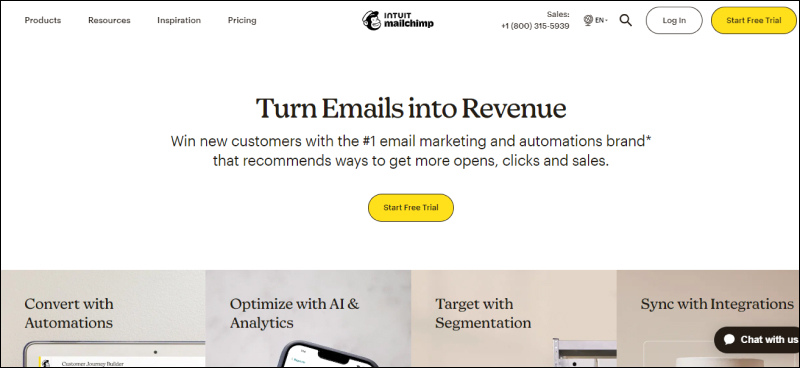
You think of an ESP, you think of Mailchimp. That’s the kind of impression Mailchimp has created. Most people start their email marketing journey here, and for a long time, it has kind of been the “default” choice. It’s packed with features, and you can do a lot more than just send emails. You get landing pages, basic CRM, audience segments, ads, and reporting all in one place.
Standout Features:
- Huge template library
- Strong editor and design tools
- Solid automation options
- CRM and audience segmentation built in
- Integrations with almost every platform
Why teams go for Mailchimp over Brevo
Mailchimp is a better fit if you want an all-in-one system rather than a basic email tool. You can manage email, landing pages and ads without switching platforms. That makes it easier to run campaigns and track performance in one place.
Design options are stronger, too. If polished branded emails matter to you, Mailchimp gives you more creative control than Brevo.
Analytics are cleaner. You can see what works and fix what doesn’t without digging.
3. Constant Contact
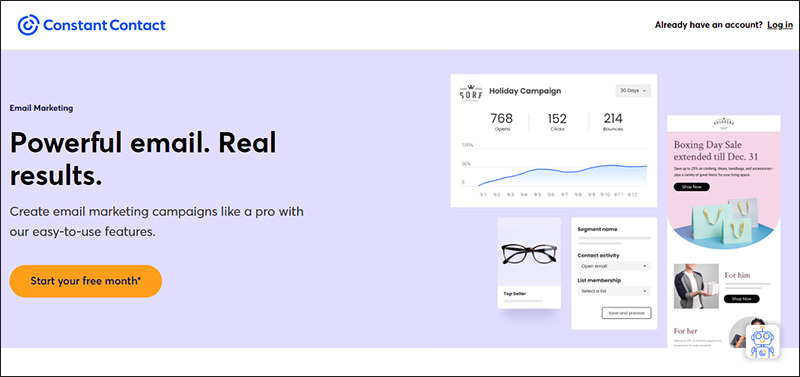
Constant Contact has been around for a long time. It’s a reliable, steady platform that a lot of small businesses and nonprofits stick with because it’s simple to manage and the support is strong. If you want a tool that feels approachable and gives you help when you need it, this is one of the safer picks.
Standout Features
- Easy list management
- Strong customer support
- Events, RSVP management and registration tools
- Email + SMS messaging
- Basic automation options
Why choose Constant Contact over Brevo
Support is the biggest difference. You can talk to an actual human when you get stuck. Phone and live chat support are available on lower plans, which is huge when a campaign is time-sensitive. Brevo only unlocks that level of support on expensive plans.
Constant Contact has another advantage – it is easy to use for multichannel campaigns. You can turn an email into a social post with one click, schedule everything at once, and keep conversations from different platforms in one place. If you manage multiple locations or multiple brands, that workflow saves hours.
For local businesses, nonprofits, real estate teams, fitness studios, or education centers — this is a tool that just feels practical. You don’t need a training session. You don’t need a strategist. You just open it and move.
Why Brevo is still a good option
Brevo is stronger for deep automation and advanced workflows. If you need heavy logic paths and multi-layer segmentation, Brevo goes further.
4. ConvertKit (Kit)
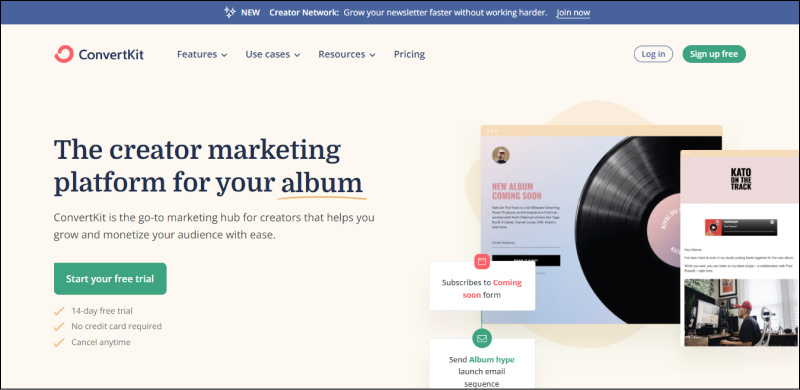
So here’s the thing about ConvertKit, now called Kit. It’s built for creators. Not corporate marketing teams. Not large ecommerce stores. Actual humans building an audience through writing, teaching, coaching, and content. If your business runs on your voice and your community, Kit gets it.
It’s designed to help you grow your list, nurture people well, and earn from your expertise without wrestling with complicated tools.
Standout Features
- A clean visual automation builder that’s easy to map out
- Strong tagging and segmentation to tailor messages
- Landing pages and opt-in forms included
- Sell digital products and subscriptions directly inside Kit
- Recommendations and Creator Network built for audience growth
- Very high deliverability (they promote a 99.8% inbox rate)
Why Kit is a better option over Brevo
Intent is where Brevo somehow falls short. Brevo is built for ecommerce and multichannel marketing. It’s great for abandoned cart flows, transactional email messaging, and heavy automation logic. That’s ideal for stores, but it can feel like overkill if you’re running a creator-led business.
Kit is lighter. The workflow feels natural. You can set up sequences, organize your audienc,e and launch offers without digging through layers of complexity. And selling digital products is already built into the platform, no need for Gumroad, ThriveCart, or connecting separate checkout tools. Brevo simply doesn’t support that model.
If your revenue comes from knowledge, community, and consistency rather than flash sales and promos, Kit tends to be the more comfortable home.
Where Brevo still wins
Brevo wins when you need deeper automation logic or multi-channel tools like WhatsApp, SMS and live chat in one system.
5. Moosend
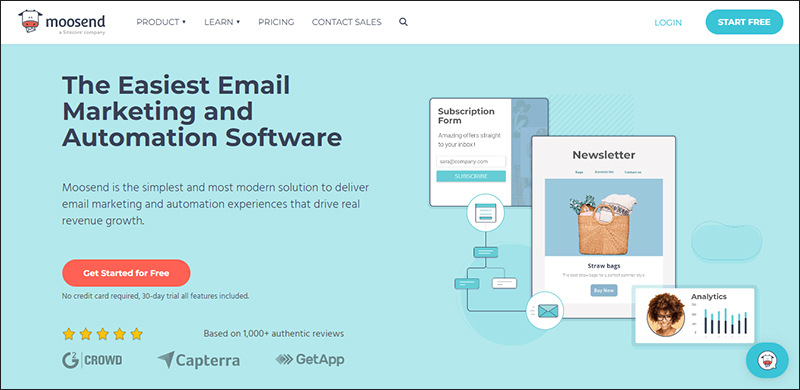
Moosend is one of the easiest email automation platforms to work with. The interface is clean. The automation builder is straightforward. You can launch campaigns fast without fighting the tool to get things done.
It’s popular with small and mid-sized teams that want more automation power than beginner tools, but don’t want the heavy operational load that comes with enterprise ESPs.
Standout Features
- Unlimited email sending even on lower tiers
- Visual automation builder that’s quick to edit
- Landing pages, forms, and templates built into the platform
- AI-assisted writing and workflow suggestions
- SMTP and transactional sending support
- Live chat and email support 24/5
Why Moosend has an advantage over Brevo
Everything comes down to speed and flexibility. As automation gets more complex, Brevo can feel heavy. Workflows take longer to adjust. Testing becomes slower. And volume-based pricing makes teams rethink their send strategy.
Moosend makes experimentation easier. You can iterate quickly. You can send more frequently without watching the cost meter climb. And you can build lifecycle automation without digging through deep configuration settings.
If your team is growing and you want room to test, learn, and scale without pricing anxiety, Moosend gives you that breathing space.
Why Brevo still wins
Brevo is stronger if you need multi-channel execution. WhatsApp, SMS, transactional email, chat, support, it’s all built in. If your strategy is ecommerce-first and relies on multiple touchpoints, Brevo still has the edge.
6. Omnisend
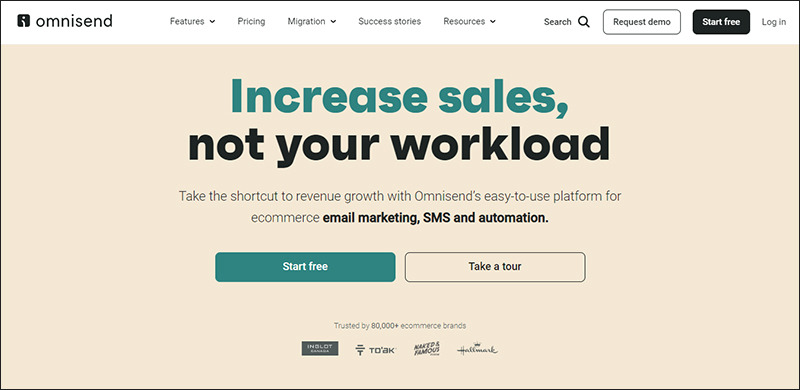
Omnisend is an ecommerce-focused automation platform built for brands that run on repeat revenue. If you sell online and rely on lifecycle programs like abandoned cart and post-purchase flows, Omnisend feels like home. It’s built to help you drive conversions without managing five different tools.
Standout Features
- Email and SMS automation built together in one workflow
- Pre-built ecommerce flows like welcome, cart recovery, browse abandon, and win-back
- Real-time segmentation based on shopping behavior
- Strong template library built for commerce-first brands
- One-click integrations with Shopify, WooCommerce, BigCommerce, and more
- 24/7 live support
Why ecommerce teams choose Omnisend over Brevo
Brevo offers automation, sure, but Omnisend is built specifically for ecommerce revenue. You get merchant-friendly workflows out of the box. You can test and optimize quickly. And you don’t need custom dev work to launch real lifecycle sequences that move the needle.
- SMS + email in one builder makes execution fast.
- Segmentation is deeper.
- Revenue reporting is clearer.
If you’re trying to squeeze every drop of value from abandoned cart, browse abandonment, and post-purchase flows, Omnisend delivers stronger ROI and stronger conversion tools. It’s built for brands that care about AOV lifts, repeat purchasing, and customer lifetime value.
Why Brevo is still a winner
Brevo is better when you need broader communication channels outside of ecommerce.
If your brand isn’t retail or DTC, or if you need transactional email and WhatsApp in one tool, Brevo may fit better.
7. Klaviyo
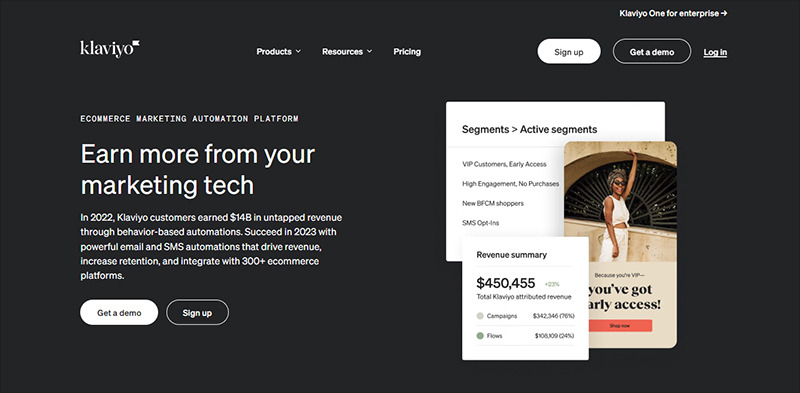
Klaviyo is built for ecommerce brands that rely on real-time email personalization and high-intent automation to drive revenue. It’s a data powerhouse. If you care about segmentation depth, predictive analytics, and lifecycle performance, Klaviyo is one of the strongest platforms in the market.
Standout Features
- Deep behavioral segmentation and advanced automation logic
- Predictive analytics for churn, lifetime value, and purchase timing
- Email, SMS, and WhatsApp under one system
- Strong ecommerce triggers: browse abandon, back-in-stock, price drop, post-purchase
- Unified customer profiles for hyper-personalized messaging
- Huge integration ecosystem for ecommerce operations
Why brands choose Klaviyo over Brevo
The shift to Klaviyo usually happens when brands outgrow basic automation and need deeper intelligence behind their messaging. Brevo is great for early-stage automation. But when you want to analyze behavior, predict intent, and build sophisticated flows, Klaviyo opens the door to a different level of scale.
Testing is easier. Targeting is sharper. You can execute complex cross-channel journeys without stitching systems together. And predictive models help you prioritize revenue opportunities instead of guessing.
If email and SMS are core revenue channels, and every percentage point matters, Klaviyo gives brands the data strength to compete at scale.
Why Brevo still has an advantage
Brevo is far more affordable for smaller teams. If you don’t need heavy data modeling or deep automation logic yet, Klaviyo can feel like too much too soon.
8. ActiveCampaign
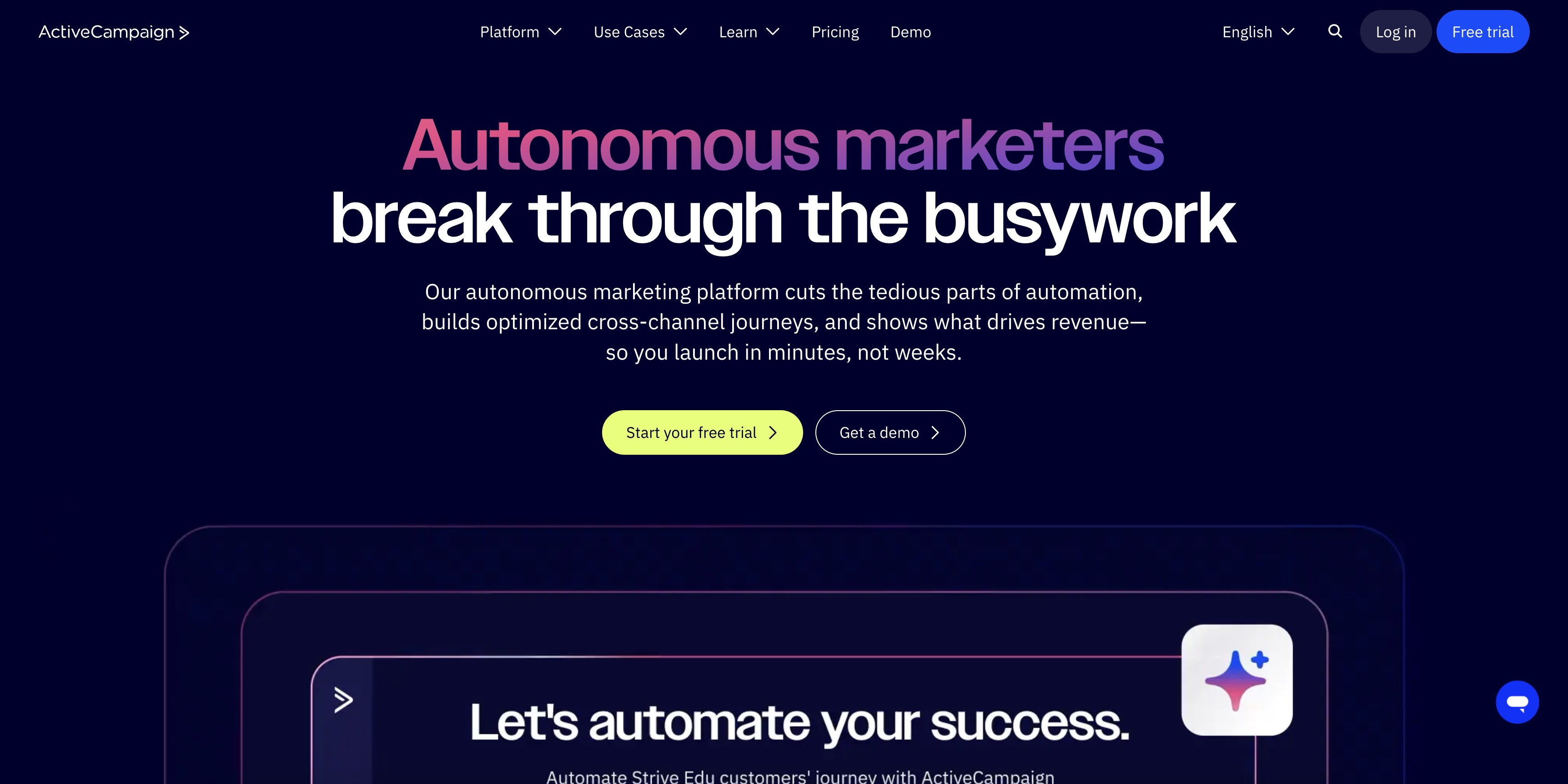
ActiveCampaign is built for teams that want automation to work harder than a simple drip sequence. If your growth depends on advanced customer journeys, decision branching, and tight alignment between marketing and sales, this platform delivers serious control. It’s built for performance, not just sending emails.
Standout Features
- Advanced workflow builder with triggers, splits, and conditional paths
- AI-guided automation strategy and content creation
- Built-in CRM and lead scoring for qualification and routing
- Email, SMS, WhatsApp, and social messaging in the same automation
- Strong reporting tied to revenue outcomes
- 1:1 onboarding support and free migration
Why teams choose ActiveCampaign over Brevo
This shift usually happens when automation becomes a priority instead of a nice-to-have. Brevo is great for straightforward campaigns. But once you need logic-based sequencing, multi-step branching, or lead scoring, Brevo starts feeling restrictive.
ActiveCampaign allows you to build complex journeys without rebuilding flows from scratch. Testing paths is faster. Personalizing based on real behavior is easier. And you can run multi-channel sequences that follow users across email, SMS, and messaging apps.
If your business runs on workflows, not broadcasts, ActiveCampaign gives you control that Brevo simply does not offer.
Why Brevo still has an advantage?
Brevo is easier to learn. If you want basic automation without the setup time or the learning curve, Brevo may be the simpler choice.
9. HubSpot
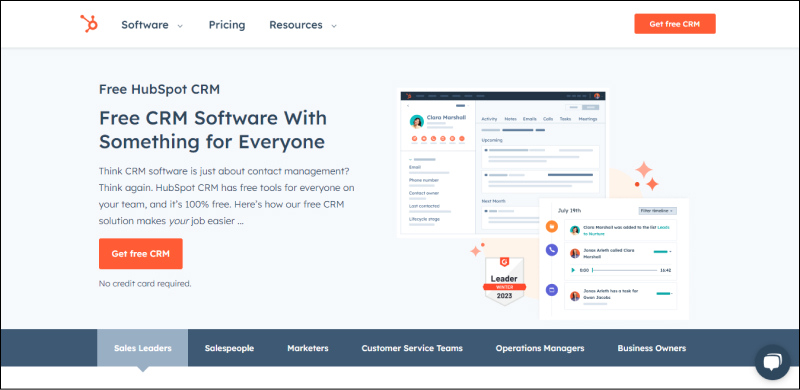
HubSpot is a full CRM and marketing platform built for teams that want everything connected in one place. It’s not just an email tool. It gives you a unified system for customer data, sales activity, service operations, content, and automation. If you need alignment across multiple functions, HubSpot makes that structure possible.
Why HubSpot still stands out
- Centralized CRM that tracks every touchpoint and conversation
- AI tools that automate repetitive tasks and surface insights
- Visual automation builder tied directly to customer records
- Built-in reporting and dashboards connected to real revenue
- Integrates with thousands of tools without manual syncing
- Works for marketing, sales, and service from the same system
Why HubSpot wins over Brevo
The biggest reason teams switch from Brevo to HubSpot is clarity. When your customer data, conversations, and email campaign performance live in separate tools, decision-making slows down. HubSpot removes that friction by giving you one platform where marketing, sales, and support all see the same real-time information. That makes it easier to prioritize opportunities, personalize communication, and understand what actually drives revenue.
Instead of guessing based on opens and clicks, you get insight into the entire lifecycle and how every interaction contributes to conversion and retention. As programs scale, that level of visibility becomes non-negotiable – and HubSpot is built to support it.
And why Brevo still stands a chance
Brevo is significantly more affordable for early-stage teams. Setup is simpler. If your needs are limited to email and basic automation, Brevo delivers great value without the commitment.
10. Sender
Sender is built for teams that want serious deliverability without enterprise complexity. It’s fast, affordable, and engineered to get emails into inboxes, not spam. More than 180,000 businesses trust Sender, which says a lot about its reliability at scale.
Standout Features
- Drag-and-drop email builder for responsive campaigns without design expertise.
- Multi-channel automation integrating email + SMS.
- Advanced audience segmentation for behavioral targeting and personalization.
- Landing pages, popups, and forms for list growth and conversions.
- Robust analytics and reporting to optimize performance quickly.
Why marketers pick Sender over Brevo
The big reason people switch is deliverability. Sender invests heavily in infrastructure, IP reputation monitoring, and compliance. You get 99.98% inbox placement, which is huge when every open counts. Brevo performs well, but the consistency here feels stronger, especially for ecommerce and high-volume campaigns.
Cost is another deciding factor. Brevo becomes expensive when send volume grows. Sender keeps pricing simple with no hidden limits. You can automate, segment, and run SMS without jumping to a high-tier plan. That freedom means you can test more, send more, and scale faster.
Teams also appreciate how easy it is to get campaigns out the door.
- Drag-and-drop builder.
- 1,600+ templates.
- -time analytics.
- Free migration and 24/7 support.
- No long setup cycles or complex configuration.
Brevo is solid for basic campaigns. Sender wins when you need high deliverability, strong support, and predictable pricing.
Why brands still choose Brevo
A lot of teams stay because Brevo does more than send emails. You get CRM, transactional messages, even WhatsApp in one place. And once everything’s already set up and running smoothly, switching tools can feel like ripping out the plumbing. Sometimes convenience wins.
11. AWeber
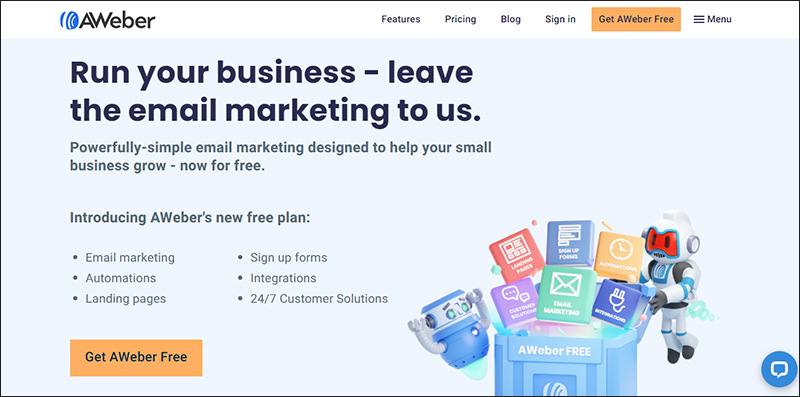
AWeber has been around for more than 20 years, and honestly, that kind of longevity matters. It’s built for creators, coaches, and small businesses that want email marketing without the learning curve. You can build landing pages, automate sales emails, and even sell digital products or subscriptions directly inside AWeber, no extra tools needed.
Standout features
- AI-assisted content creation for subject lines, newsletters, and full email drafts.
- Easy drag-and-drop builder with built-in Canva access and branded template generation.
- Behavior-based automation for onboarding, follow-ups, and re-engagement.
- Unlimited landing pages and ecommerce tools for selling products and subscriptions.
- High-level deliverability infrastructure engineered to protect inbox placement.
Why choose AWeber over Brevo
If you want a platform that lets you sell and take payments right inside your emails, AWeber makes it ridiculously easy. Set up a store in minutes. Accept payments in 100+ currencies. Run subscriptions. Brevo can’t do that directly.
Support is another big deal. AWeber gives you phone and live chat support even on free plans. With Brevo, you only get that level of support on higher-priced plans. If you like having real humans to talk to, AWeber is worth a serious look.
Plus, automation is fast. They give you 90% pre-built automations so you can plug in your content and go live fast. No complicated setup. No headaches. Just launch and watch it work.
Brevo is great if you want multichannel marketing.
AWeber wins when you want simple automation, fast setup, and built-in payments without extra tools.
Why some brands still stick with Brevo
Some brands stay because Brevo offers more channels in one place – email, SMS, WhatsApp, and CRM. And once everything is already running smoothly, switching feels like a bigger project than they want to tackle.
Are Brevo Alternatives Better? Yes. But Here’s Why Brevo is Still an Excellent Platform.
Over the last decade, I have worked with enough email and automation platforms to know that there is no universal winner. Every tool shines for a particular type of business and marketing maturity stage. While Brevo does have challenges (especially if you’re running complex automation or require mature API infrastructure), it continues to hold real value for a very large segment of users.
For many early-stage businesses, solopreneurs, nonprofits, and smaller ecommerce stores, Brevo delivers something genuinely compelling: capability without overwhelming setup time or cost. And that matters, particularly when a team doesn’t yet have specialized marketing talent or advanced CRM workflows.
For many businesses, advanced capabilities aren’t the goal on day one. They just want to get campaigns out the door, build lists, and maintain communication. Brevo makes that possible with minimal friction.
Conclusion
Selecting the right email marketing platform comes down to how well it aligns with your stage of growth and the level of sophistication you need. Brevo remains a strong choice for early-stage businesses and lean teams that want an affordable, unified system for email, SMS, and transactional messaging without complexity.
As your program expands and automation depth, segmentation precision, and experimentation become essential, other platforms offer more flexibility and control. Tools like MailerLite, Moosend, Omnisend, Klaviyo, and ActiveCampaign provide stronger workflow capabilities, richer data handling, and scalable performance built for revenue-driven environments.
In simple terms –
- Brevo delivers an accessible starting point.
- The alternatives deliver more power when your marketing engine matures.
If you need guidance in evaluating or transitioning to a better-fit platform, our team at InboxArmy can help you choose a solution that supports your growth path with clarity and confidence.






Leave a Comment